
Few dog owners believe their dog will become lost—until it happens.
A gate is left open. A leash or piece of equipment fails. A dog slips out of a vehicle. Fireworks begin unexpectedly. Thunder cracks overhead. A rabbit runs across a trail. Something frightens a dog in an unfamiliar place, and within seconds, a companion who normally stays close is running away.
Once fear, excitement, or instinct takes over, even a well-trained dog may behave differently than its owner expects.
That is why lost-dog safety should begin long before a dog is ever missing.
At Armor K9, we believe preparation involves two responsibilities: reducing the likelihood that your dog becomes lost and knowing what to do if prevention fails.
Identification, tracking technology, thoughtful handling, reliable training, and a recovery plan can dramatically change what happens during those first critical minutes and the hours that follow.
Because when a dog disappears, the goal isn't simply to search harder.
It is to respond intelligently.
How Dogs Become Lost
Dogs become lost in ordinary situations more often than most owners expect. It does not require negligence or an obviously dangerous environment. Sometimes it takes only a few seconds and the right combination of circumstances.
An unsecured gate or door is an obvious risk, but dogs can also slip collars, pull free from handlers, escape damaged fencing, jump from vehicles, or bolt while being loaded or unloaded. Equipment that has worked hundreds of times can fail. Someone unfamiliar with the household routine may unknowingly leave an exit unsecured.
Then there are situations that change the dog's behavior.
Fireworks are a particularly important example. A dog that has never attempted to leave the yard may suddenly climb, dig, push through, or clear a barrier when frightened by explosions. Thunderstorms, gunfire, construction noise, vehicle accidents, and other sudden events can produce a similar flight response.
Prey and chase behavior can create another kind of disappearance. A rabbit, squirrel, deer, or other animal may draw a dog's attention long enough for distance to develop remarkably quickly.
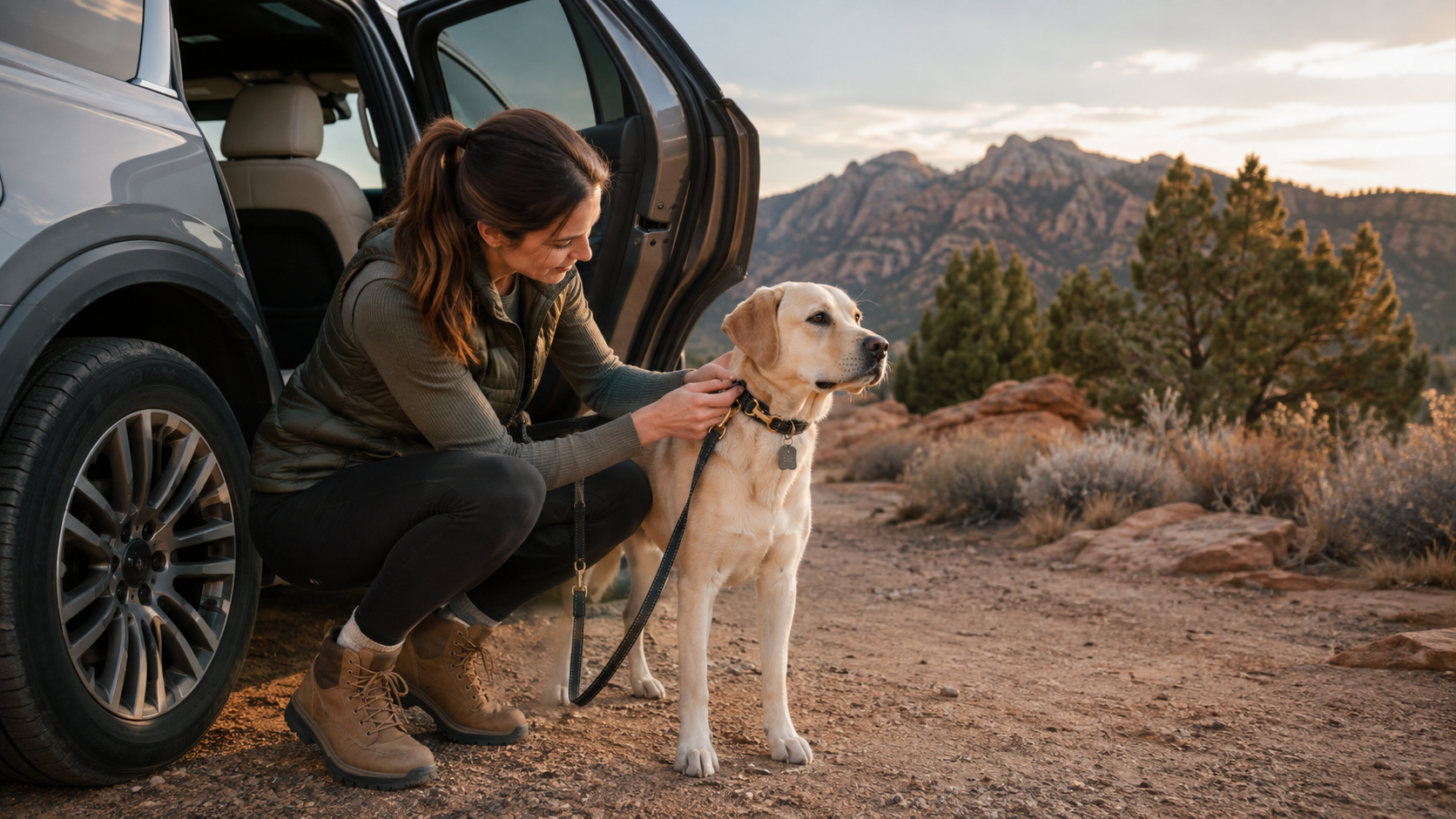
Unfamiliar environments deserve additional caution. Travel, camping, hiking, veterinary visits, training locations, hotels, vacation homes, and stops along the road remove many of the geographic cues and routines a dog normally recognizes. If the dog gets loose, it may have no familiar route home, known location to return to, or understanding of where its owner will be. What might be a short-lived escape near home can become a much more difficult recovery in unfamiliar surroundings.
The important lesson is not that dogs are unpredictable.
It is that circumstances can change faster than an owner expects.
Good prevention accounts for that possibility before it happens.
Identification Before You Need It
If your dog becomes lost, identification can turn a stranger finding your dog into a phone call home.
A properly fitted collar with an identification tag remains one of the simplest safeguards. The information should be current and include a phone number where you can actually be reached. Periodically check the tag itself as well. Engraving wears, tags break, and contact information changes.
A microchip provides an important second layer of identification, particularly if the dog's collar is lost or removed. But implantation alone is not enough. The chip must be registered, and the owner's contact information must remain current. If you move or change phone numbers, updating the microchip registration should be part of the process.
Keep several recent photographs of your dog on your phone, including clear images of the dog's face, body, coloring, and any distinctive markings. In an emergency, these are far more useful than trying to find a good photograph while under stress.
It is also worth keeping your dog's microchip number and registration information somewhere you can access quickly.
None of these measures prevents a dog from becoming lost.
They make it easier for someone who finds your dog to help bring your dog home.
GPS and Tracking Devices
Identification helps when someone finds your dog. A tracking device may help you find the dog yourself.
Modern GPS and location trackers can provide an enormous advantage when a dog gets loose, particularly in unfamiliar areas or places where a dog can cover substantial distance quickly. Instead of relying entirely on sightings and guesswork, an owner may be able to establish the dog's location, direction of travel, and whether the dog is continuing to move.
We recently saw exactly how valuable that can be.
After completing rattlesnake avoidance training, a dog unexpectedly bolted from its owner. What followed was a recovery effort lasting just over eight hours. Fortunately, the owner had equipped the dog with a tracking device. That did not make the recovery easy, but it provided information that otherwise would not have been available and played an important role in ultimately locating the dog.
A tracker, however, should never create a false sense of security. Devices depend on factors such as battery life, attachment, cellular or satellite coverage, terrain, and the particular technology being used. A tracker can also be lost if a collar comes off.
Think of tracking technology as another layer of protection rather than a substitute for identification, secure equipment, good handling, or training.
And if you use one, do not wait for an emergency to learn how it works. Keep it charged, periodically confirm that it is functioning, and know how to access your dog's location quickly.
When a dog is missing, that is not the time to discover you have forgotten the password.
Build Recovery Into Everyday Training
Training cannot guarantee that a dog will never get loose. It can, however, give an owner more options when something goes wrong.
A reliable recall is one of the most valuable behaviors a dog can learn. It should not only mean coming when nothing else is going on. It should still work when there are distractions, excitement, movement, and competing interests.
Door and gate manners matter for the same reason. A dog that has learned not to rush through an opening simply because one appears has another layer of protection built into everyday life. The same principle applies when getting into and out of vehicles. A dog should not assume that an open door means permission to exit.
Owners should also understand the limitations of training.
A frightened dog can enter a very different state of mind. Fireworks, an accident, an unexpected confrontation, or another intense event may produce a level of fear or arousal that the owner has never encountered during normal training. A dog that ordinarily recalls reliably may hesitate, avoid approaching, or continue moving.
That does not make training unimportant. It makes preparation more important.
Reliable obedience gives you tools. Good handling reduces the likelihood that you will need them. Identification and tracking provide additional safeguards when both are not enough.
The strongest lost-dog prevention strategy does not depend on any single one of them.
The First Minutes Matter
When a dog gets loose, the natural reaction is often immediate pursuit. Sometimes that is appropriate. Sometimes it can turn an escape into a chase.
The first priority is to remain observant. Note the dog's direction of travel, where you last had a clear visual, and what may be influencing where the dog is going. Roads, traffic, terrain, other animals, people, water, and nearby hazards can quickly become important.
If the dog is still responsive to you, use the recall and commands the dog already knows. Avoid repeatedly calling or shouting the dog's name if it is clearly not producing a response. Increasing your own urgency can sometimes increase the dog's excitement or fear.
If possible, keep the dog in sight without driving it farther away. A dog moving freely can cover considerable distance, but knowing where the dog is is often more valuable than closing that distance too aggressively and causing it to run farther.
If you have a GPS tracker, this is when preparation pays off. Begin tracking immediately and preserve your phone's battery. If another person is available, one person can concentrate on the dog's location while the other begins coordinating the recovery effort.
Most importantly, recognize when the situation has changed.
You are no longer simply trying to get your dog to come back.
You are trying to recover a loose dog safely—and the way you approach that problem may determine what the dog does next.
Why Chasing a Lost Dog Can Make Things Worse
Seeing your dog and being unable to reach it can be one of the most frustrating moments in a recovery. Every instinct may tell you to close the distance.
That is not always what the dog needs.
If a loose dog is frightened, confused, or highly aroused, someone moving directly toward it may create pressure. The dog moves away, the person follows, and without intending to, the person has created a chase. Additional people joining the pursuit can make the situation worse.
Even the dog's owner may not receive the response they expect. A dog that is normally affectionate and eager to approach can avoid eye contact, keep its distance, or run from familiar people when frightened.
If the dog is visible but unwilling to approach, slow things down. Avoid surrounding it or sending multiple people toward it. Depending on the dog and circumstances, reducing pressure, turning sideways, sitting or crouching at a distance, moving away rather than toward the dog, or using familiar cues may give the dog an opportunity to make a different decision.
Food, a familiar toy, another dog the missing dog knows well, or an open vehicle door may also be useful—but what works depends on the individual dog.
At this point, the priority is no longer enforcing obedience or expecting the dog to behave as it normally would. The priority is getting the dog home safely.
That may require changing your approach based on what the dog is showing you.
Sometimes the fastest way to accomplish that is to stop chasing.
Searching Intelligently
If the dog is no longer in sight, resist the temptation to simply start driving or walking in every direction. A successful search depends on collecting information and using it.
Start with the last confirmed location and direction of travel. Consider what lies ahead: roads, neighborhoods, trails, open land, water, shade, livestock, wildlife, familiar places, and physical barriers that may influence the dog's movement.
Think about the individual dog as well. A social dog may move toward people, homes, or activity. A frightened dog may avoid them. A dog with strong prey drive may continue following wildlife. In hot weather, a dog that has been moving for hours may eventually seek water or shade.
As sightings come in, record the location and time. A series of reliable sightings can begin to reveal a direction or pattern. If you have multiple people helping, designate one person to collect that information so everyone is working from the same picture.
Be careful about flooding an area with searchers. More people do not automatically make a search more effective. Vehicles, unfamiliar voices, people calling the dog's name, and individuals approaching from different directions can unintentionally keep a frightened dog moving.
When possible, maintain a familiar point the dog can return to. Depending on where the dog was lost, that might be a home, campsite, vehicle, or another safe location associated with the owner. Avoid abandoning an important location simply because the search has expanded elsewhere.
A good search is not measured by how many miles people cover.
It is measured by whether each new piece of information helps narrow where the dog is likely to be.
Getting Help Without Creating Chaos
There comes a point when recovering a lost dog requires more people. The key is making those people useful rather than simply adding more activity.
Start with a clear, current photograph and basic information: the dog's name, description, last confirmed location, time last seen, and a reliable contact number. Include an important instruction that is often overlooked: whether people should approach the dog. If the dog is frightened or running from people, asking well-intentioned strangers to chase, call, or attempt to catch it can make recovery more difficult.
Contact local animal control agencies, shelters, veterinary clinics, and other organizations that may receive a found dog. Community and neighborhood social-media groups can spread information quickly, particularly when sightings are reported with accurate locations and times.
If friends, family members, or volunteers are helping with the physical search, give them specific assignments. Some may watch roads or likely travel corridors. Others may check shelters, monitor online reports, or remain at an important return location. Someone should keep track of confirmed sightings and communicate changes to the group.
Distinguish between confirmed information and speculation. A reported sighting several miles away can redirect an entire search, so details matter. Ask when the dog was seen, exactly where it was, which direction it was traveling, and whether the person is confident it was the missing dog.
As the search grows, coordination becomes increasingly important.
Twenty people independently looking for a dog can create twenty different searches.
Twenty people working from the same information can create one recovery effort.
When You See the Dog but Cannot Catch It
Finding the dog is not always the same as recovering the dog.
After hours—or sometimes days—on the loose, a dog may be tired, frightened, thirsty, injured, or highly alert to anything approaching it. An owner may finally have the dog in sight and naturally feel an overwhelming urge to close the distance. This is one of the moments when patience can matter most.
If the dog moves away when approached, pay attention to that response. Continuing to advance may simply move the dog again. Give the dog room and, when circumstances allow, allow it to settle.
Keep unnecessary people and vehicles away from the immediate area. If someone has eyes on the dog, maintaining visual contact from a safe distance may be more valuable than repeatedly attempting to catch it.
Use what is familiar to that individual dog. That might include the owner's voice, food, a favorite toy, another familiar dog, a vehicle, crate, leash, or routine the dog recognizes. The purpose is to create an opportunity for the dog to approach voluntarily rather than continually increasing pressure.
If repeated attempts are unsuccessful, particularly with a frightened dog that has established itself in an area, professional assistance may be appropriate. Animal control personnel, experienced lost-dog recovery specialists, or humane trapping resources may provide options that a growing group of searchers cannot.
And when the dog finally comes within reach, stay composed. Secure the dog before celebrating. Attach the leash, close the vehicle door, secure the crate, or move into an enclosed area.
Recovery is complete only when the dog is safely contained.
After Recovery
The moment a lost dog is safely contained brings enormous relief. Before assuming everything is fine, take a few minutes to evaluate the dog carefully.
A dog that has been loose may have traveled much farther than anyone realizes. Check the paws and pads for cuts, abrasions, thorns, burns, or other injuries. Look over the legs and body for wounds, swelling, tenderness, bites, or signs that the dog may have been struck or injured.
Consider the conditions the dog experienced while missing. Heat, cold, dehydration, exhaustion, traffic, wildlife, and unfamiliar terrain can create problems that are not immediately obvious. If the dog appears weak, disoriented, injured, unusually lethargic, has difficulty breathing, or otherwise does not seem right, veterinary evaluation may be appropriate.
Give Your Dog Time to Settle
Coming home does not necessarily mean the experience is over for the dog.
Depending on how long the dog was missing and what happened while it was loose, you may notice changes in behavior for a period after recovery. The dog may sleep more than usual, seem unusually quiet, stay closer to you, appear restless, eat or drink differently, or react more strongly to sounds and surroundings.
Initially, give the dog an opportunity to rest, drink, eat appropriately, and settle back into familiar surroundings. Avoid overwhelming it with visitors or unnecessary excitement.
Then begin returning to your normal routine.
Dogs often benefit from the familiarity of the life they already know. Normal feeding times, walks, household rules, obedience, play, exercise, and appropriate expectations can all help reestablish that rhythm. Allowing a dog to spend days moping while everyone worries over it may feel compassionate, but it does not necessarily help the dog recover.
This does not mean ignoring what the dog has experienced. Watch the dog, make reasonable allowances for fatigue or soreness, and respond appropriately if something appears physically or behaviorally wrong. But unless there is a reason not to, begin showing the dog that life is returning to normal.
For the next several days, supervision should also increase. Do not assume that because the dog has been recovered it will not attempt to leave again. Whatever originally caused the escape may still exist, and the dog may need time to settle completely back into its household routine.
Most importantly, do not punish the dog for having run away. The opportunity to address the escape was before it happened, through preparation, handling, training, and management. After recovery, determine what failed and correct that problem going forward.
Watch the dog rather than the calendar. Most dogs should gradually return to their normal behavior as familiar structure and routine are restored. Significant or persistent behavioral changes—or anything that causes concern—deserve further evaluation.
Getting your dog physically home is the first part of recovery.
Helping your dog return to normal life completes it.
Once the dog is safe and its immediate needs have been addressed, determine how the escape happened.
Was a gate left unsecured? Did equipment fail? Did the dog slip a collar? Did fireworks or another sudden event trigger the escape? Did the dog rush through a vehicle door? Was there a breakdown in training, handling, or household routine?
The purpose is not to assign blame.
It is to prevent the same set of circumstances from producing the same result again.
Replace failed equipment. Update identification. Recharge or reconsider tracking equipment. Address weaknesses in fencing, gates, household procedures, or training. If something surprised you about your dog's behavior, incorporate what you learned into your future preparation.
Bringing the dog home ends the search.
Learning from the escape helps keep the next search from ever beginning.
Prevention Is the Better Recovery Plan
No collar, fence, tracking device, microchip, or level of training can eliminate every possibility that a dog will become lost. Good preparation does something more realistic: it reduces the opportunities for an escape and gives you better options if one occurs.
Know where your dog is. Maintain gates and fencing. Use properly fitted equipment. Build good habits around doors and vehicles. Keep identification and microchip information current. If you use a tracking device, keep it charged and know how to use it.
And prepare for predictable situations before they arrive.
If fireworks are expected, secure your dog before the first explosion—not after the dog becomes frightened. The same principle applies to storms, travel, unfamiliar environments, and other circumstances that may change your dog's behavior.
Most importantly, understand your individual dog. Training matters, but so does recognizing when fear, excitement, or instinct has changed the situation and your approach needs to change with it.
We recently watched a dog remain missing for more than eight hours before finally being recovered. Experiences like that are a powerful reminder of how quickly an ordinary day can become something very different.
Fortunately, preparation can change the outcome.
The best time to prepare for a lost dog is while the dog is still standing beside you.