
Living With Rattlesnakes in Arizona
Rattlesnakes are part of life in Arizona. For dog owners, that does not mean living in fear of every trail, backyard, or patch of desert. It means understanding that we share the environment with an animal capable of seriously injuring a dog.
Encounters are not limited to remote desert trails. Rattlesnakes can appear in neighborhoods, yards, around homes, and in many of the same outdoor spaces where Arizona families and their dogs spend their time.
The goal is not to eliminate every possibility of an encounter. That simply is not realistic. The goal is to recognize where the risk exists, reduce unnecessary exposure, maintain reasonable control of your dog, and know what to do when an encounter occurs.
Awareness changes the way you see the environment. Once you know where to look and what circumstances deserve additional attention, rattlesnake country becomes something to navigate thoughtfully—not something to fear.
Where Dogs and Rattlesnakes Cross Paths
Rattlesnakes do not have to be far out in the desert to present a risk to your dog. In Arizona, encounters can happen surprisingly close to home.
Around residential properties, rattlesnakes may seek shelter beneath or behind air-conditioning units, along patios, near door thresholds, around landscaping, beneath outdoor furniture or equipment, and in other protected areas. Rock features, stacked materials, sheds, garages, and areas with vegetation can also provide places where a snake may go unnoticed.
Away from home, washes, rocky areas, brush, trail edges, and places that provide shade or cover deserve additional attention. The surroundings can change quickly, particularly when a dog leaves an open trail to investigate something nearby.
Dogs can also create their own path toward an encounter. A rabbit or lizard disappearing into rocks, brush, or another sheltered area may be irresistible to a dog inclined to chase. Unfortunately, those are often the same kinds of places a rattlesnake may use for shelter.
This is one reason simply watching for snakes is not enough. Watch where your dog is going and what has captured its attention. Sometimes the greater warning is not the snake you can see, but the place your dog is determined to investigate.
When Rattlesnakes Are Active
Arizona's rattlesnake season cannot always be reduced to a particular month on the calendar. Temperature, elevation, weather, and location all influence when snakes become active.
As temperatures warm, rattlesnake activity generally increases. During hotter periods, their activity may shift toward cooler parts of the day and into the evening or nighttime hours. At other times, a snake may be encountered warming itself in the sun or moving between areas of shelter.
Elevation matters as well. Conditions in Prescott and Northern Arizona can be very different from those in the Phoenix area on the same day. A dog owner traveling between elevations may move from relatively cool conditions into active rattlesnake country in a matter of hours.
Weather changes can matter too. A warm day following cooler weather can create conditions where snakes become active when an owner may not be expecting them.
The practical lesson is simple: do not let the calendar determine your awareness. If conditions are favorable for rattlesnake activity, pay attention to where you are walking, where your dog is investigating, and what may be concealed around you.
In Arizona, awareness should follow the conditions—not simply the season.
Why Dogs Are Particularly Vulnerable
Dogs experience the environment differently than we do. They lead with their noses, investigate movement, follow scent, and often put their face directly into places a person would never consider reaching.
That natural curiosity can put a dog's face and front legs dangerously close to a rattlesnake before the owner realizes a snake is present.
Sometimes the dog is not interested in the snake at all.
A rabbit darting into brush or a lizard disappearing beneath a rock can trigger a dog's instinct to chase. The dog's attention remains fixed on the animal as it follows it into vegetation, rocks, equipment, or another sheltered area—the same types of places rattlesnakes may use for cover.
Even a well-supervised dog can move faster than its owner can recognize the danger and intervene.
This is an important reality for Arizona dog owners. Your awareness is important, but it cannot always protect a dog from something you cannot see.
Whenever possible, the dog should have an opportunity to recognize the danger as well—and make the decision to move away from it.
Your Dog Needs to Recognize the Danger, Too
Rattlesnake avoidance training adds something owner awareness alone cannot provide: recognition by the dog.
The purpose is not to make a dog afraid of the outdoors or suggest that a trained dog can never be bitten. It is to teach the dog that rattlesnakes are something to avoid and create distance from.
That matters because an encounter can unfold in seconds. A dog that recognizes the danger has an opportunity to respond without first waiting for its owner to recognize the snake and intervene.
Owner awareness and avoidance training therefore serve different purposes. You learn to recognize circumstances that may put your dog at risk. Your dog learns to recognize something it should avoid.
Together, they provide a more complete approach to living with dogs in rattlesnake country.
The Rattle Is a Warning, Not a Guarantee
The unmistakable sound of a rattlesnake's rattle is one of nature's most effective warnings. But dog owners should never depend on hearing it before recognizing that a snake is nearby.
A rattlesnake may remain still and quiet when approached. It may attempt to escape or rely on its camouflage rather than immediately giving a warning. Even when a snake does rattle, surrounding noise, distance, wind, or simple distraction may prevent you from hearing it.
Dogs may also become aware of a snake before we do. Their sense of smell and awareness of their immediate surroundings are different from ours, and a sudden change in your dog's behavior may deserve your attention.
The absence of a rattle does not mean the absence of a rattlesnake.
For Arizona dog owners, the better habit is to remain aware of the environment rather than relying on the snake to announce its presence.
Reducing Risk Around Your Home
You cannot make an Arizona property completely free of rattlesnakes, but you can make the areas where your dog spends time less inviting to them and easier for you to monitor.
Start by paying attention to places that provide cover. Keep vegetation reasonably maintained and avoid unnecessary clutter around areas your dog regularly uses. Wood piles, stacked materials, equipment, dense landscaping, and other sheltered spaces deserve particular attention.
Look beyond the obvious hiding places. Check around patios, door thresholds, garages and sheds, and behind or around air-conditioning units before allowing a dog to investigate an area you cannot clearly see.
Food sources matter as well. Rodents can attract snakes, so reducing conditions that encourage rodents around the property can help reduce one of the reasons rattlesnakes may be there in the first place.
Most importantly, develop the habit of looking before your dog investigates. A few seconds of awareness when opening a door, walking around the side of the house, or entering an area that provides good cover can prevent an unnecessary encounter.
The goal is not to create a perfectly controlled environment. It is to remove unnecessary opportunities for a dog and rattlesnake to surprise one another.
Reducing Risk on Walks, Trails, and Outdoor Adventures
Arizona offers extraordinary places to explore with a dog, and rattlesnake awareness should help you enjoy them more safely—not keep you from them.
Pay attention to more than the trail immediately in front of you. Watch the edges of the trail, rocks, brush, washes, and other areas that provide cover. Be especially aware when your dog becomes intensely interested in something you cannot see.
Maintaining control of your dog is important. A dog ranging well ahead of its owner or disappearing into brush can encounter a snake before the owner has an opportunity to intervene. A reliable recall and appropriate leash use give you more ability to prevent an investigation from becoming an encounter.
Be cautious about allowing a dog to push its nose into holes, beneath rocks, through dense vegetation, or into other areas where visibility is limited. The same applies when a rabbit, lizard, or other animal suddenly gives your dog something exciting to pursue.
Awareness does not require walking Arizona's trails expecting a rattlesnake behind every rock. It means recognizing the situations where an encounter is more likely and making thoughtful decisions before curiosity or prey drive puts your dog somewhere you cannot protect it.
What to Do When You See a Rattlesnake
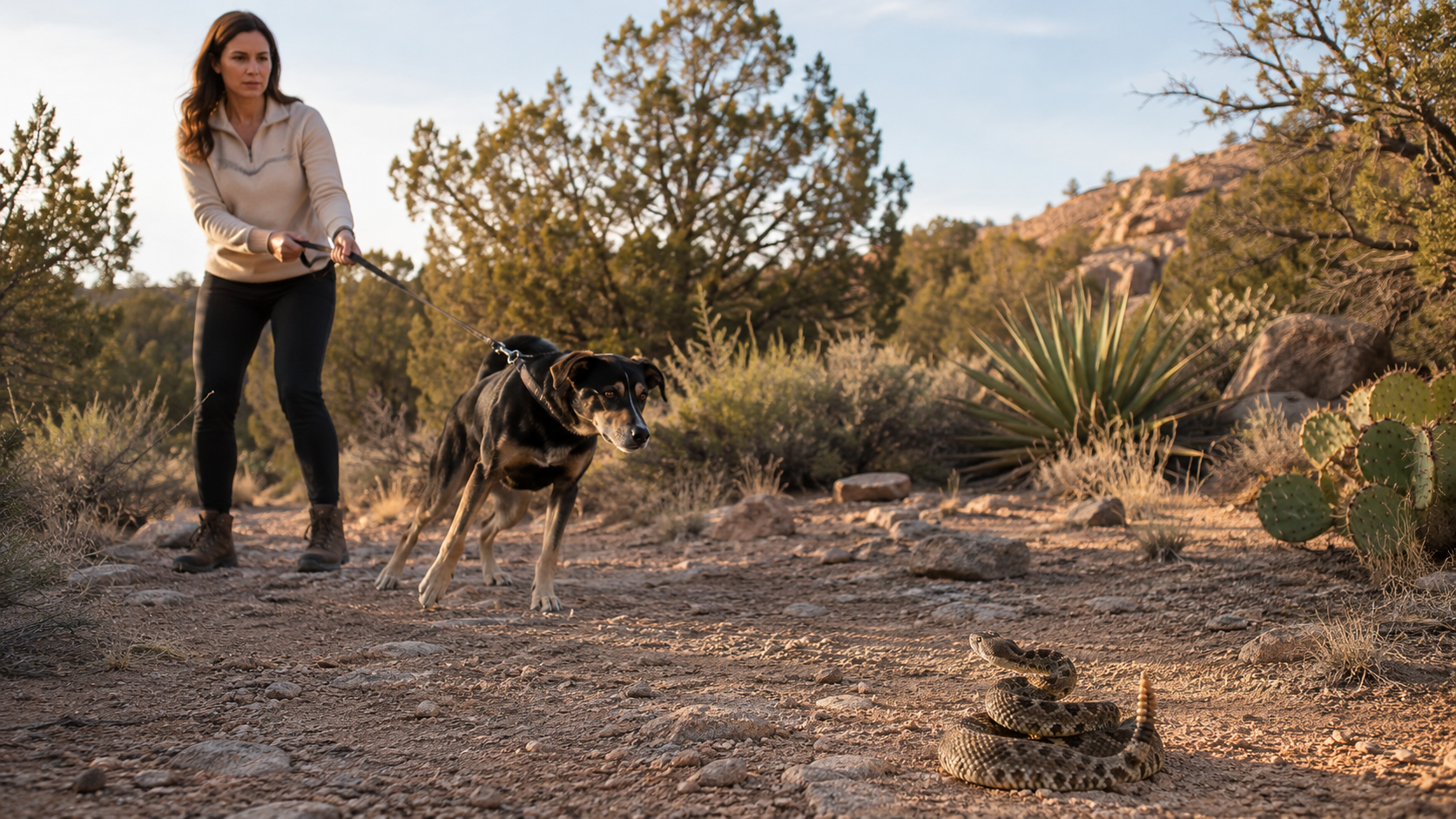
If you encounter a rattlesnake with your dog, your first priority is simple: create distance.
Bring your dog under control and move away calmly. Give the snake room rather than attempting to move, provoke, photograph up close, or otherwise interact with it.
If the snake is between you and where you intended to go, change your route. There is rarely a good reason to force your way past it.
Around your home, the same principle applies. Secure your dog away from the area before dealing with the situation. Do not allow the dog to continue investigating simply because the snake appears motionless or has stopped rattling.
And remember that a rattlesnake does not become harmless simply because it appears to be dead. Avoid allowing your dog to approach or investigate a dead or injured snake.
The safest rattlesnake encounter is generally a short one: recognize it, control your dog, create distance, and leave the snake alone.
If You Suspect Your Dog Has Been Bitten
A rattlesnake bite should be treated as a veterinary emergency.
Sometimes an owner sees the strike. Other times, the first indication may be sudden pain, swelling, puncture wounds, bleeding, weakness, difficulty walking, or an abrupt change in the dog's behavior. The appearance and severity of a bite can vary, so the absence of dramatic symptoms should not be used as a reason to wait.
If you know or suspect your dog has been bitten, contact a veterinarian or emergency veterinary hospital immediately and begin making your way there. If possible, calling ahead gives the veterinary team an opportunity to prepare for your arrival.
Keep your dog as calm and quiet as reasonably possible during transport. Do not waste valuable time attempting home remedies. Cutting the bite, attempting to suck out venom, applying ice, or using a tourniquet can cause additional harm or delay appropriate veterinary care.
You do not need to capture or kill the snake. Doing so creates another opportunity for a bite. Never approach a snake simply to identify it.
When a rattlesnake bite is suspected, the priority is not identifying the snake or determining how serious the bite appears.
The priority is getting your dog veterinary care as quickly as possible.
What About Benadryl?
Dog owners in rattlesnake country sometimes hear that they should give their dog diphenhydramine (Benadryl) after a rattlesnake bite.
Benadryl does not neutralize rattlesnake venom and should not be considered a treatment for the envenomation or a substitute for emergency veterinary care. Veterinarians may use diphenhydramine in certain circumstances, but whether it is appropriate for an individual dog is a veterinary decision.
If you spend time with your dog in rattlesnake country, talk with your veterinarian in advance about whether they want you to carry diphenhydramine and, if so, exactly what product and dose they recommend for your dog.
If a bite occurs, do not delay getting to a veterinarian in order to administer Benadryl or other first aid.
Rattlesnake Avoidance Is One Layer of Protection
Rattlesnake avoidance training does not replace responsible ownership, environmental awareness, or veterinary care. It adds another layer of protection.
The objective is for the dog to recognize a rattlesnake as something to avoid and choose distance rather than investigation.
No responsible trainer should suggest that rattlesnake avoidance training guarantees a dog will never be bitten. Animals, environments, and circumstances are never completely predictable. Training is about reducing risk, not promising immunity from it.
For Arizona dog owners who regularly hike, hunt, camp, live on rural property, or simply have dogs spending time outdoors, professional rattlesnake avoidance training can be a sensible part of preparing for the environment in which they live.
Awareness belongs to the owner.
Avoidance belongs to the dog.
The strongest approach includes both.
Be aware. Be prepared. Then go enjoy Arizona with your dog.