
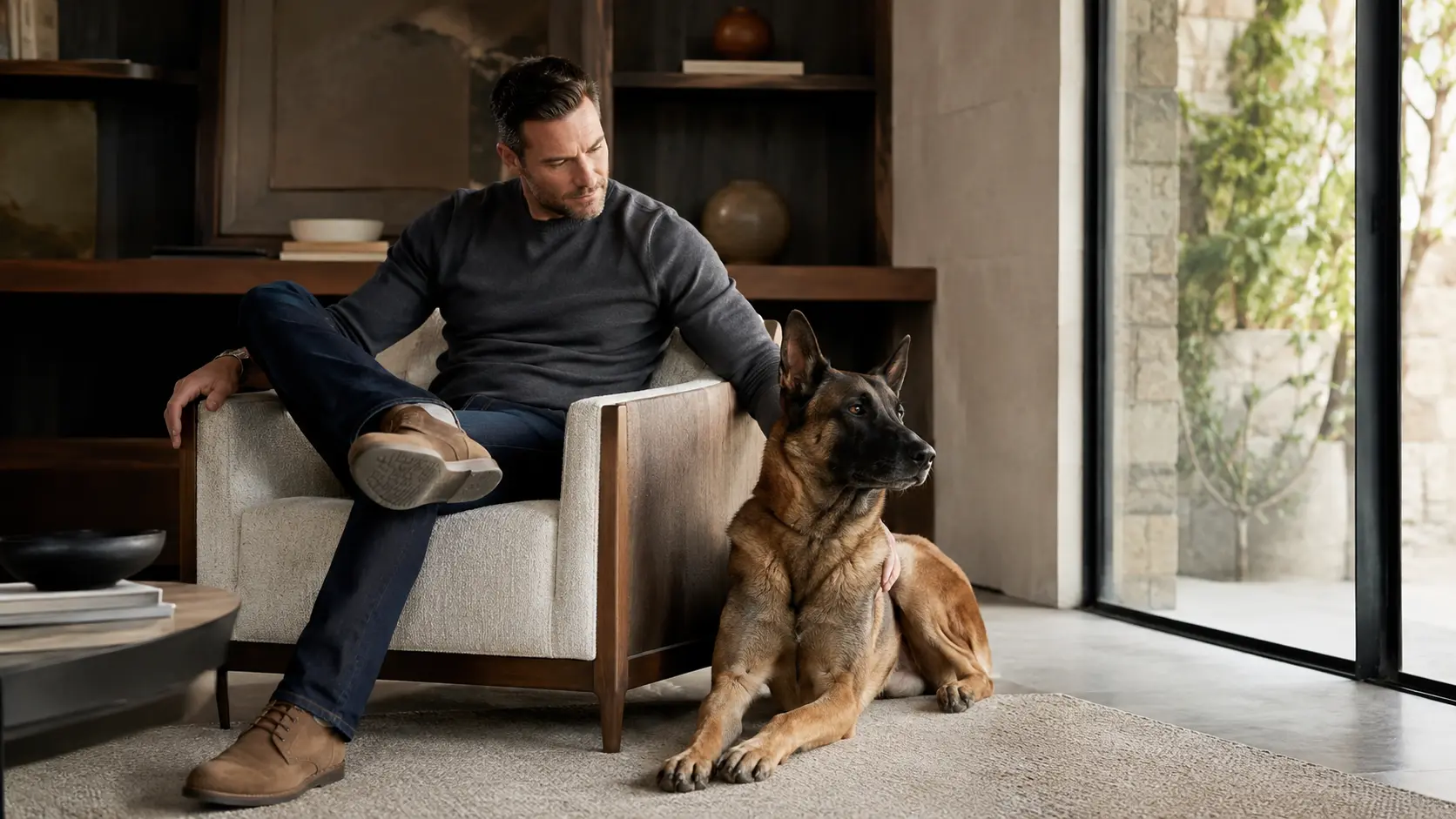
Most days with a family protection dog should not feel dramatic.
The dog should live as a trusted companion—resting in the home, accompanying the family, participating in ordinary life, and providing a controlled capability that is present if genuinely needed.
The purpose is not to make a family feel as though it must live on constant alert. It is to give them greater confidence to live freely.
At Armor K9, we often say:
Companion first. Protector second.™
That is not simply a description of what the dog can do. It is a description of what daily life with the right dog should feel like.
A Companion Living Naturally Within the Family
A family protection dog should be part of the family—not a security tool kept apart from it.
The dog may rest beside you while you work, settle near the family during dinner, accompany you on a morning walk, ride with you while running errands, or spend the evening quietly in the home. It becomes familiar with the rhythms of the household and learns where it belongs within them.
Like any meaningful relationship, the bond develops through shared experiences. The dog learns the family’s routines, expectations, voices, and patterns. The family learns the dog’s personality, communication, and needs.
Over time, the dog’s presence becomes natural. Protection remains part of its capability, but companionship defines most of its life.
Calm Behavior Inside the Home
A capable protection dog should not spend its life pacing, barking, or reacting to every sound.
Inside the home, the right dog should be able to settle.
It should understand when to rest, where it is expected to remain, and how to behave during the normal movement of family life. Children may play. Deliveries may arrive. Friends may visit. Someone may knock at the door. These ordinary events should not create unnecessary chaos.
This calmness is not the absence of awareness. A well-developed dog can remain observant without being anxious or disruptive.
That balance is an important part of Strength Under Control.™
Daily Routines, Walks, Errands, and Recreation
Living with a family protection dog includes many of the same activities people enjoy with any well-mannered companion.
The dog may join the family for walks, hiking, outdoor recreation, road trips, visits to dog-friendly businesses, or relaxed time on the patio. Where permitted, it may accompany an owner to work, settle calmly during appropriate activities, or ride along during the day.
These experiences are not separate from the dog’s development. They help strengthen communication, reinforce expectations, and deepen the relationship between the dog and its owner.
The dog should understand that ordinary life is exactly that—ordinary. Its default role is not confrontation. Its default role is to remain composed, responsive, and connected to its handler.
The Confidence Created by the Dog’s Presence
One of the most meaningful benefits of living with a family protection dog is difficult to measure until you experience it: the confidence created by the dog’s presence.
Walking through a parking lot at night may feel different. Being home alone may feel different. Traveling, stopping in unfamiliar places, or answering an unexpected knock at the door may feel different.
The dog does not eliminate the need for awareness, judgment, or sensible security practices. What it can provide is another layer of capability—one that is present with you rather than installed in a building or left behind when you travel.
That presence can create reassurance without requiring fear.
The goal is not to think constantly about what might happen. The goal is to know that you are better prepared if something does.
Deterrence Without Confrontation
A family protection dog may provide value without ever being required to physically intervene.
The visible presence of a composed, capable dog can discourage unwanted attention and cause someone to reconsider approaching, following, or entering a space.
This is deterrence without confrontation.
The dog does not need to bark at everyone, lunge at strangers, or behave aggressively to communicate capability. In fact, unstable or uncontrolled behavior often creates more problems than it prevents.
A calm dog standing beside its owner can send a much clearer message.
In many situations, presence alone may be enough.
The Bond Between the Dog and Its Family
A family protection dog is not merely trained to perform tasks. It develops a genuine relationship with the people in its life.
That bond grows through leadership, structure, affection, shared routines, and trust. The dog learns to look to its owner for direction. The owner learns how to communicate clearly and consistently.
This relationship is central to both companionship and protection.
The dog is not expected to make every decision independently. It works within a framework established by its handler. The owner remains responsible for interpreting circumstances, providing direction, and maintaining control.
At Armor K9, we describe that relationship simply:
The owner is the General. The dog is the Private.
The dog may possess exceptional capabilities, but those capabilities are strongest when supported by clear leadership and a meaningful bond.
Living Appropriately Around Visitors
A protection dog should not prevent a family from welcoming people into its home.
With proper selection, development, introductions, and owner leadership, the dog can learn to behave appropriately around friends, relatives, service providers, and other invited guests.
That may mean resting on place while someone enters, remaining neutral during a conversation, or joining the household appropriately after the owner has established that the visitor is welcome.
The exact routine may differ among families and dogs. A quiet household with occasional guests may need something different from a family that regularly entertains, employs household staff, or has children bringing friends home.
This is one reason Armor K9 begins by understanding the family before recommending a dog. The dog must be able to live successfully within the household that actually exists.
Traveling and Participating in Public Life
For many families, a protection dog needs to be capable of going far beyond the home.
The dog may travel by vehicle, stay in hotels, enter elevators, move through crowds, accompany the family to outdoor destinations, or adapt to unfamiliar surroundings and changing schedules.
A properly selected and prepared dog should be able to experience new environments without treating everything unfamiliar as a problem. It should remain responsive to its owner, behave appropriately around the public, and settle when the activity ends.
Not every dog is suited to every travel schedule or lifestyle. Frequent travel, limited vehicle space, commercial or private aviation, climate, destination restrictions, and the family’s preferred activities can all influence candidate selection.
When travel is an important part of the family’s life, it should be considered from the beginning—not treated as an afterthought.
Obedience and Protection Beneath Ordinary Companionship
Most people who encounter a properly developed family protection dog may never see its full capabilities.
They may simply see a dog walking politely beside its owner, resting quietly in the home, waiting calmly at a doorway, or enjoying time with the family.
Beneath that ordinary companionship is a foundation of obedience, control, environmental confidence, and protection development.
Those capabilities should not dominate daily life. They should support it.
The dog knows how to respond to familiar commands. The owner understands how to direct and manage the dog. Both have practiced the skills necessary to maintain control under changing circumstances.
Protection is not supposed to be a constant performance. It is a capability that exists beneath the surface of a stable, manageable companion.
Your Relationship With Armor K9 Continues After Delivery
Delivery is not the end of Armor K9’s relationship with the family.
A successful placement includes helping the owner understand the dog, develop effective handling skills, establish household expectations, and begin building the relationship correctly.
As the family and dog gain experience together, new questions may arise. Routines may change. The family may travel, move, welcome a child, introduce another animal, or encounter situations that were not part of the original transfer process.
Armor K9 remains a resource as that relationship develops.
Continued guidance, training opportunities, and participation in the Arizona Protection Dog Club can help owners maintain skills, strengthen communication, and keep the dog’s capabilities controlled and reliable.
The objective is not simply to deliver a trained dog. It is to create a successful, lasting placement.
Living More Freely
A family protection dog should not make life feel smaller.
It should not cause the family to avoid visitors, withdraw from public life, or view every unfamiliar person as a threat. It should not create an atmosphere of anxiety inside the home.
The right dog should add companionship, capability, and confidence to the life the family already wants to live.
There will be responsibilities. The owner must provide leadership, structure, rules, consequences, and consistency. Skills must be maintained, expectations reinforced, and the dog’s physical and emotional needs met.
But those responsibilities exist in service of something larger: a trusted relationship with a dog that can share ordinary life while providing an extraordinary capability.
Most days should consist of quiet moments, familiar routines, shared activities, and companionship.
That is exactly the point.
Protection is the skill. Companionship is the purpose.
Schedule Your Complimentary 15-Minute Protection Dog Evaluation
If you are considering a family protection dog, the next step is a private, complimentary 15-minute evaluation with Armor K9.
We will begin with your family, lifestyle, routines, expectations, and concerns—not with a breed or a dog we are trying to sell. From there, we can determine whether a family protection dog—and Armor K9’s placement process—may be the right fit.