
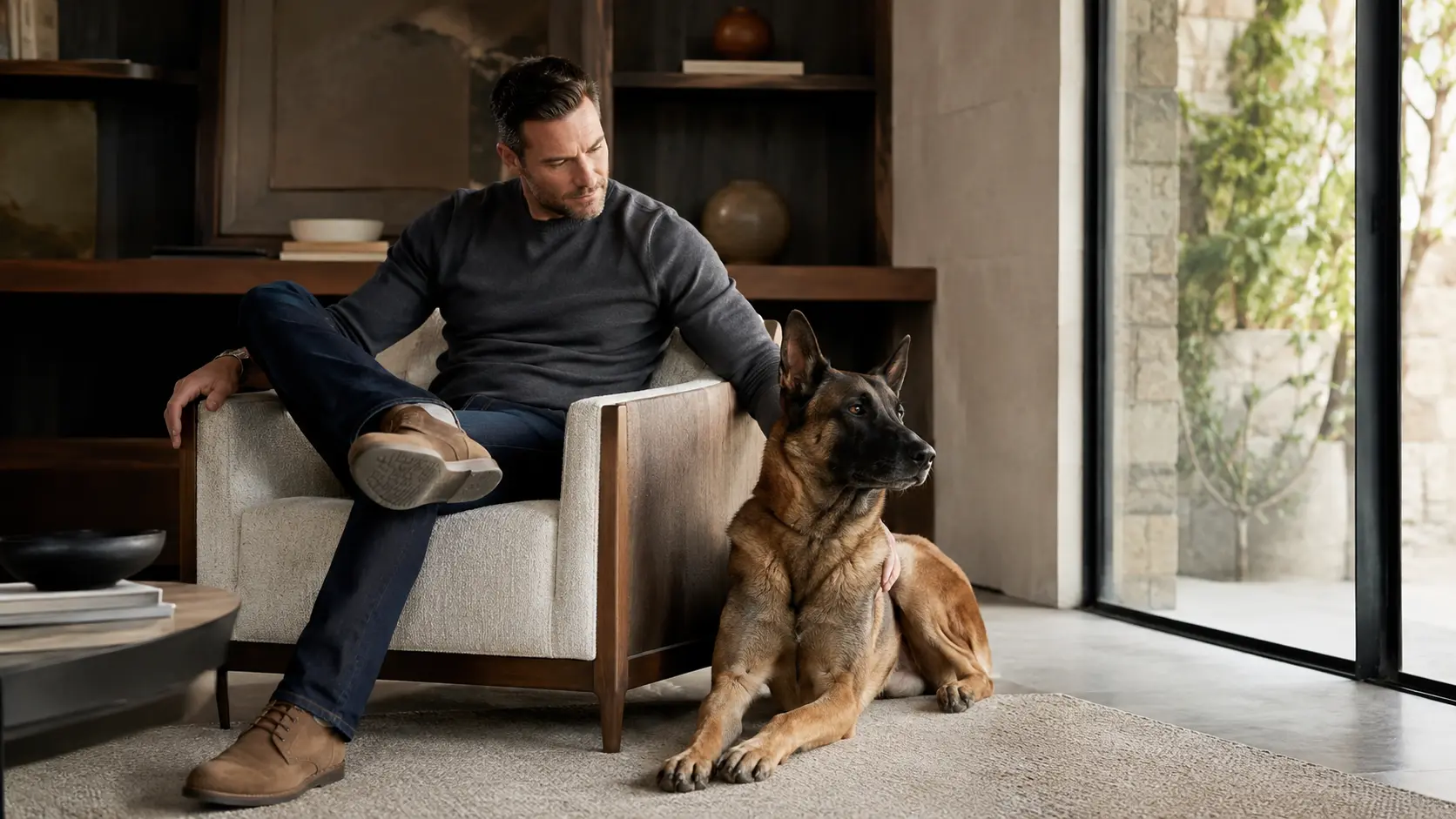
Yes. The right family protection dog can become a capable traveling companion—one that remains close to the family, adapts to changing surroundings, and extends its protective presence beyond the home.
That mobility is one of the meaningful advantages of a family protection dog. Cameras, alarms, lighting, and locks remain attached to a property. A dog can accompany its family between residences, on the road, into appropriate public environments, and to many of the places where life actually happens.
Travel also allows the relationship between the family and the dog to deepen. Long drives, quiet evenings in unfamiliar accommodations, outdoor activities, and time spent navigating new environments together can strengthen trust and companionship.
Successful travel does require preparation. Hotels, elevators, airports, unfamiliar rooms, changing schedules, luggage, strangers, and other animals place demands on a dog that may not appear within the familiar routines of home.
For families who travel frequently, those circumstances should be considered before a dog is selected. The objective is not simply to find a dog that can tolerate travel. It is to identify and develop an individual capable of traveling comfortably, confidently, and under control within the life the family actually leads.
The Advantages of Traveling With the Right Dog
A properly selected and prepared family protection dog can contribute something fixed security measures cannot: a familiar protective presence that moves with the family.
The dog may accompany its owner during road trips, stays at a second residence, outdoor recreation, hotel visits, private aviation, and other suitable travel. Its presence may provide deterrence, awareness, companionship, and greater confidence in unfamiliar surroundings.
The dog also brings continuity. The destination may change, but the relationship, communication, rules, and expectations shared between the dog and its owner remain familiar.
For someone arriving at an unfamiliar property, walking through a parking area after dark, staying alone in a hotel, or traveling between residences, that combination of companionship and controlled capability can be meaningful.
Protection is not the dog’s only contribution. A well-matched dog should also be able to settle during long drives, relax in temporary accommodations, participate appropriately in daily activities, and remain a trusted companion throughout the trip.
Companion first. Protector second.™
Vehicle Travel
For many families, vehicle travel is the most common way their protection dog accompanies them.
A dog that travels regularly should be comfortable entering and exiting the vehicle under direction, remaining settled while the vehicle is moving, and waiting for permission before leaving. An appropriate crate, vehicle kennel, restraint system, or other secure arrangement should be selected for the dog and vehicle.
Once those expectations are established, many dogs come to understand vehicle travel as part of ordinary life. They learn when to settle, when to exit, and how to move with the family efficiently.
Armor K9 also teaches dogs to relieve themselves on the “Hurry up” command. This can make fuel stops, hotel departures, airport schedules, and other time-sensitive travel situations easier to manage.
The vehicle may also become part of the dog’s working environment. A suitable dog should remain composed around traffic noise, parking areas, people approaching the vehicle, and the loading and unloading of luggage. Protective capability should remain controlled rather than developing into indiscriminate territorial behavior around the vehicle.
Temperature management is essential. A parked vehicle can become dangerous quickly, even when outside conditions appear moderate. Travel plans must account for fuel stops, meals, appointments, and circumstances in which the dog cannot accompany the handler inside.
A running vehicle, strong air conditioning, remote temperature monitoring, and alerts can be part of a carefully designed plan, but they should not be presented as making an unattended dog automatically safe. Engines can stop, air-conditioning systems can fail, cellular alerts can be delayed, and conditions can become dangerous quickly.
Hot-weather travel requires redundant safeguards and advance planning. Depending on the conditions, the correct decision may be to keep the dog with you, arrange a climate-controlled indoor location, leave the dog with a qualified caregiver, or not bring the dog on that particular trip.
With the proper vehicle arrangement, preparation, and temperature plan, road travel can become a comfortable and familiar part of life for both the dog and the family.
Hotels and Unfamiliar Accommodations
A suitable family protection dog can learn to settle in hotels, vacation rentals, ranches, second residences, and other temporary accommodations.
The surroundings may be unfamiliar, but the dog still has something familiar: its handler, equipment, commands, rules, and daily relationship.
Hotel life introduces sounds and activity that the dog may not encounter at home. Voices through walls, housekeeping carts, closing doors, elevators, and people passing immediately outside the room should not produce uncontrolled barking, pacing, or inappropriate protective behavior.
Once inside the room, the dog should be able to inspect the new environment, accept direction, and settle. Familiar bedding, a travel crate, established place training, and consistent routines can help the dog understand what is expected.
The handler should deliberately manage interactions with employees, housekeeping personnel, maintenance staff, and other guests. If someone needs to enter the room, the dog can be secured or placed under appropriate control before the door is opened.
Before booking accommodations, the family should confirm:
- Whether dogs are permitted
- Whether breed, size, or weight restrictions apply
- Whether additional deposits or fees are required
- Whether the dog may be left unattended
- Whether a crate is required
- Where appropriate exercise and relief areas are located
A protection dog does not automatically receive the access rights granted to a legally recognized service dog. Its protective role should never be misrepresented to obtain access to lodging, transportation, or other places where ordinary dogs are restricted.
When the accommodations are appropriate and the dog has been prepared, staying away from home does not need to be disruptive. It can become another routine the dog learns to navigate with its family.
Private and Commercial Air Travel
Some family protection dogs can travel successfully by air, but private and commercial aviation present very different circumstances.
Private aviation generally provides greater flexibility. Cabin arrangements, boarding procedures, relief planning, and handling can often be discussed with the operator in advance. The dog must still be comfortable with aircraft noise, confined space, vibration, unusual movement, ground crews, and unfamiliar terminals.
The flight crew or operator should know that a dog will be traveling so that restraint, cabin placement, boarding, and emergency considerations can be addressed before departure.
Commercial air travel is more restrictive. Protection training alone does not qualify a dog as a service animal. Airline policies, aircraft limitations, crate requirements, destination rules, and restrictions affecting particular breeds or routes may determine whether transportation is available and how it must occur.
Families should confirm current requirements directly with the airline before purchasing tickets. Policies and available transportation options can change, and an arrangement permitted on one route or airline may not be available on another.
For families who fly frequently, aviation requirements should be part of the initial conversation with Armor K9. The dog’s size, temperament, environmental confidence, health, ability to settle, and comfort with confinement may all influence suitability.
Air travel is possible for some protection dogs. The important question is whether the individual dog, transportation method, and itinerary are compatible.
Public Environments, Crowds, Elevators, and Luggage
Travel places the dog beside its owner in environments where conditions change quickly.
A traveling family protection dog may encounter:
- Crowded entrances and narrow hallways
- People approaching from multiple directions
- Elevators shared with strangers
- Rolling luggage and baggage carts
- Automatic doors and reflective surfaces
- Children moving unpredictably
- Unfamiliar dogs in confined areas
- Loudspeakers, traffic, machinery, and sudden noises
A well-prepared dog should remain composed, responsive, and physically manageable in those settings, including around children moving unpredictably. The dog does not need to interact with everyone it encounters. Neutrality—the ability to notice activity without becoming unnecessarily involved—is often more valuable.
Elevators require deliberate handling because people or animals may enter a confined space with little warning. The handler can position the dog appropriately, maintain control, and wait for another elevator when additional space would be preferable.
Luggage adds another practical consideration. A person managing bags, children, identification, tickets, or hotel check-in may have less attention and fewer free hands available. Reliable obedience and thoughtful planning allow the dog to remain settled while the handler attends to the rest of the trip.
These capabilities are not merely for demonstrations. They allow the dog to move appropriately through the ordinary complications of real life.
Maintaining Control Around Unfamiliar People and Animals
Travel increases the number of people, animals, and circumstances the family cannot control.
Strangers may reach toward the dog without permission. Children may run past. Another traveler may allow a dog to approach on a retractable leash. Hotel employees may knock or enter unexpectedly. Some people may behave differently around a dog they perceive as impressive, intimidating, or unusual.
The handler remains responsible for interpreting circumstances, maintaining appropriate distance, giving clear direction, and preventing unnecessary interactions.
The dog should remain aware without treating every unfamiliar person or animal as a threat. This balance—awareness without indiscriminate behavior—is part of what allows the dog to accompany the family successfully.
If the handler is uncertain about someone’s intentions, the dog may be placed on Watch while the situation is evaluated. As explained in What a Family Protection Dog Can—and Cannot—Do, that capability exists within a controlled framework established by the handler.
The owner is the General; the dog is the Private.
Clear leadership allows the dog’s capabilities to remain useful without preventing the family from participating in ordinary life.
Preparing the Dog for Changing Routines
Travel changes many familiar parts of the dog’s day: sleeping location, feeding schedule, exercise opportunities, elimination areas, environmental stimulation, and time spent near the handler.
Preparation helps those changes become manageable rather than overwhelming.
Depending on the dog and destination, preparation may include:
- Short vehicle trips before longer drives
- Overnight stays in unfamiliar locations
- Entering and settling in elevators
- Exposure to rolling luggage and transport equipment
- Resting calmly in a travel crate
- Maintaining obedience in busy public environments
- Eating, drinking, and relieving on a modified schedule
- Remaining neutral around unfamiliar people and animals
- Entering temporary accommodations under control
The goal is not to expose the dog to every possible situation. That would be impossible. The goal is to develop sufficient stability, confidence, and responsiveness for the dog to navigate reasonable changes successfully.
The handler’s consistency provides an important anchor. The location may change, but familiar commands, expectations, equipment, and leadership help the dog understand that the same relationship remains in place.
Should the Dog Accompany Every Trip?
Not necessarily—and that flexibility is an advantage.
A family protection dog can be an important traveling companion without attending every business meeting, flight, vacation, or activity. Thoughtful owners consider what will be best for the dog, the family, and the purpose of the trip.
A road trip to a private residence with appropriate space and predictable routines may be an excellent opportunity to bring the dog. A short commercial flight followed by long meetings in a restrictive hotel may offer little benefit to the dog or owner.
Before deciding, consider:
- Whether the dog is permitted at the destination
- Whether the dog can remain with the handler during planned activities
- Whether suitable exercise and relief areas are available
- How much time the dog would spend confined or alone
- Whether the climate can be managed safely
- Whether the transportation method suits the dog
- Whether bringing the dog meaningfully contributes to the trip
The purpose is to make a deliberate decision based on the destination, itinerary, and needs of the dog and family rather than assuming the same choice is correct for every trip.
A sound care plan gives the family options. The dog can travel when its presence is appropriate and remain safely with a qualified caregiver when it is not.
Care Arrangements When the Dog Remains Home
A reliable caregiver allows the family to travel confidently when bringing the dog would not be practical.
The person or facility should be capable of following the dog’s established rules and routines. They should understand the dog’s equipment, commands, feeding schedule, exercise needs, household boundaries, and relevant medical or behavioral considerations.
Because protection dogs possess capabilities that ordinary pet-care providers may not encounter regularly, the caregiver should be selected and prepared in advance.
Preparation may include introducing the caregiver, familiarizing the dog with the facility, reviewing written handling instructions, and completing a trial stay before an extended trip.
Emergency veterinary information, owner contact details, authorization for medical care, and an alternate decision-maker should also be provided.
Knowing that an appropriate care arrangement already exists gives the family greater freedom. Travel decisions can then be based on what makes sense for each trip rather than on the absence of a suitable alternative.
International Travel and Destination Restrictions
International travel with a dog can be rewarding, but it requires advance planning.
Requirements may include:
- Microchip documentation
- Vaccination records
- Veterinary health certificates
- Import permits
- Parasite treatments
- Blood testing
- Government endorsements
- Airline-approved crates
- Advance notice to animal-control or agricultural authorities
- Quarantine or inspection upon arrival
- Documentation for returning to the United States
Some countries, territories, municipalities, airlines, and lodging providers restrict particular breeds or dogs fitting certain physical descriptions. Transit countries may also impose requirements even when they are not the final destination.
Because rules can change, families should verify current requirements with the appropriate government authorities, airline, private aviation operator, lodging provider, and veterinarian well before departure.
For some destinations, the process is manageable with sufficient preparation. In other cases, quarantine requirements, transportation limitations, or the length of the trip may make a qualified caregiver the better choice.
International travel should be approached as a planning decision—not automatically ruled out and not assumed to be simple.
Why Travel Requirements Affect Candidate Selection
Travel compatibility cannot be added equally to every dog after selection.
A family that travels between residences, stays in hotels, flies privately, attends public events, or spends extended periods on the road may need a dog with particular qualities.
Those qualities may include:
- Strong environmental stability
- Confidence in unfamiliar surroundings
- The ability to settle for extended periods
- Neutrality around strangers and other animals
- Physical manageability in confined spaces
- Comfort with vehicles, crates, and changing routines
- A temperament suited to repeated transitions
- Reliable responsiveness when the handler is distracted
Breed may suggest certain tendencies, but it cannot answer these questions by itself. As explained in What Is the Best Breed for a Family Protection Dog?, the individual dog’s temperament, health, size, energy, experience, recovery, and relationship with the handler all matter.
This is why Armor K9 begins by understanding the family before searching for the dog.
If travel is part of your life, it should be discussed during the initial evaluation. Where you travel, how frequently you travel, how you get there, where you stay, who accompanies you, and what you expect the dog to do all help define the right candidate.
The objective is not merely to find a dog capable of protection.
It is to find a stable companion with the ability to move confidently through life beside you—and the controlled capability to respond when genuinely needed.
Protection is the skill. Companionship is the purpose.
Schedule Your Complimentary 15-Minute Protection Dog Evaluation
If you are considering a family protection dog and travel is part of your lifestyle, the next step is a private, complimentary 15-minute evaluation with Armor K9.
We will begin with your family, travel patterns, destinations, transportation methods, daily routines, expectations, and protection needs to determine whether a protection dog—and Armor K9’s process—may be an appropriate fit.