A properly developed family protection dog can make a meaningful contribution to a family’s safety. The dog may discourage an unwanted approach, alert the family to something unusual, remain composed during uncertainty, and respond with controlled intervention when a genuine threat requires it.
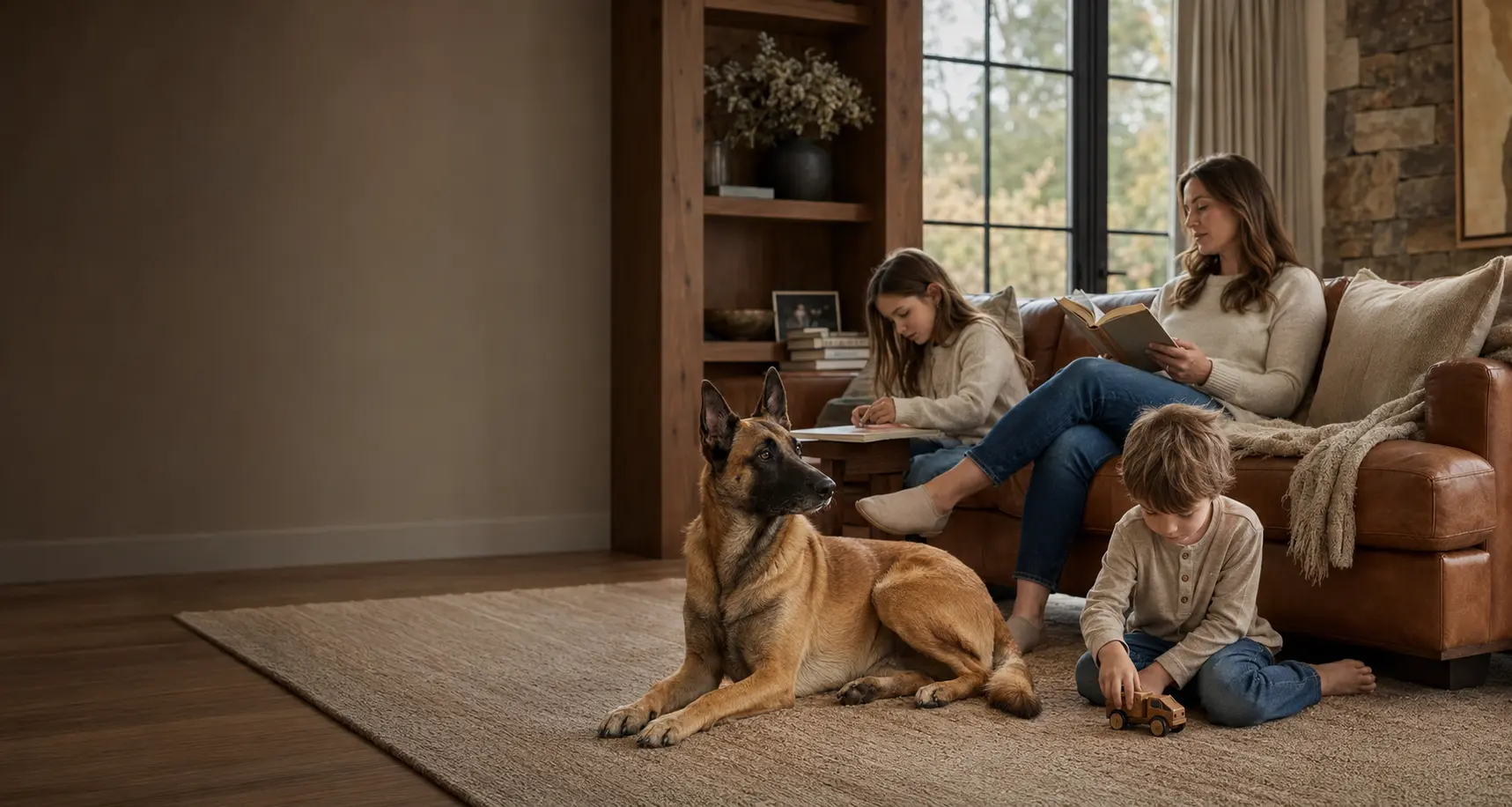
Just as importantly, the right dog can live as a trusted companion within the home.
What no dog can do is eliminate risk, make every decision for its owner, or guarantee a family’s safety.
Understanding that distinction is essential. A family protection dog is neither an alarm system with teeth nor an independent security solution. It is a capable living partner whose value depends on temperament, development, placement, owner leadership, and the judgment of the people responsible for it.
What a Properly Developed Dog Can Contribute
The presence of a suitable dog can change the way a potential threat perceives a person, vehicle, or home. In many situations, that visible presence may be enough to discourage someone from continuing an approach.
Deterrence is valuable because the best confrontation is often the one that never develops.
A properly developed dog may also provide:
- Awareness and alerting. Dogs often notice movement, sound, proximity, or a change in their environment before the people around them do. An alert can give the owner additional time to observe, assess, and respond.
- A visible protective presence. A stable, confident dog beside its owner can cause a person with harmful intent to reconsider the opportunity.
- Controlled intervention. When circumstances are uncertain, the handler can place the dog on Watch. The dog remains attentive and under control while the handler assesses the situation. If someone attacks the handler, the dog is free to assist without waiting for an additional command. The dog can also intervene when directed and must remain responsive to the handler’s control.
- Confidence and companionship. The dog lives within the family, participates in ordinary life, and provides the relationship expected of a trusted companion—not merely the appearance of security.
These contributions are significant. None of them make the dog infallible, and none should be separated from the circumstances in which the dog will actually live.
Deterrence Is More Than Appearance
A large dog, a certain breed, or an intimidating appearance may create an impression. Appearance alone, however, does not establish protective capability.
Meaningful deterrence is supported by the dog’s composure, environmental confidence, responsiveness to its owner, and ability to remain clear-headed when circumstances become uncertain. A dog that appears formidable but becomes unstable, avoidant, indiscriminate, or uncontrollable under pressure may create risk rather than reduce it.
The objective is not uncontrolled aggression. It is Strength Under Control.™
Alerting Is Not Decision-Making
A dog may recognize that something has changed without understanding the full meaning of the situation.
The person approaching the house could be an intruder, a neighbor, a delivery driver, a first responder, a child’s friend, or a family member arriving unexpectedly. The dog can draw attention to the event. The owner must interpret it.
That is why alerting should be understood as an early-warning contribution—not proof of danger and not permission for the dog to make every decision independently.
Controlled Intervention Is Not Indiscriminate Action
A family protection dog should not move through everyday life deciding independently whom to confront or when intervention is appropriate.
That does not mean the dog must always wait for an additional command while its handler is being attacked.
Armor K9 uses a Watch command for situations in which the handler is uncertain of another person’s intentions. Watch places the dog in a controlled state of readiness while the handler observes, evaluates, and manages the encounter.
If the situation remains nonthreatening, the dog remains under control. If someone attacks the handler, the dog is free to assist without waiting for another command.
This is not uncontrolled or indiscriminate aggression. It is a defined response within a framework established by the handler. The handler initiates Watch, remains responsible for the situation, and must retain the ability to direct or call the dog out of action.
At Armor K9, we describe that relationship simply: the owner is the General; the dog is the Private.
The dog possesses specialized capabilities and limited authority within clearly established circumstances. The owner provides leadership, evaluates developing situations, avoids unnecessary conflict, and remains responsible for controlling the dog.
A dog that cannot be controlled is not providing responsible protection.
A Protection Dog Is Not an Autonomous Security System
Electronic security systems can monitor doors, record activity, illuminate an area, notify an owner, or summon assistance. A dog does something different. It perceives and responds as a living animal, influenced by training, experience, environment, health, stress, and the guidance of its handler.
That makes the dog remarkably adaptable, but not mechanical or error-proof.
A protection dog cannot:
- Monitor every part of a property at all times
- Reliably interpret every unfamiliar person or unusual event
- Replace locks, lighting, cameras, alarms, or emergency planning
- Determine the legal or tactical consequences of using force
- Compensate indefinitely for poor handling or inconsistent household rules
- Guarantee the outcome of a violent encounter
The dog should be understood as one capable part of a broader approach to family safety—not the entire plan.
Owner Leadership Is Not Optional
The effectiveness of a family protection dog does not end with the dog’s development. It continues through the owner’s daily leadership.
Leadership does not mean harshness. It means providing structure, setting clear rules, enforcing appropriate consequences, and remaining consistent. It means understanding the dog’s behavior, maintaining its obedience and working capabilities, and preventing avoidable situations before they become problems.
Every capable dog brings responsibility with it. The more a dog can do, the more important sound handling becomes.
This is also why placement cannot be based only on what a client wants the dog to do. It must account for how the family lives, who will handle the dog, the home environment, children, other animals, travel, visitors, routines, experience, and the owners’ willingness to maintain the standards the dog requires.
No Dog Can Guarantee a Family’s Safety
Responsible protection work begins with an honest acknowledgment: there are no guarantees in a violent or unpredictable event.
A dog may create time, distance, warning, deterrence, or an opportunity to move away from danger. The dog may interrupt an assault or help prevent one from beginning. Those possibilities can be meaningful, but the outcome of any event will depend on factors no trainer, owner, or dog can completely control.
Claims of guaranteed protection ignore reality. They also encourage families to place confidence in a promise that no responsible professional should make.
The purpose of a family protection dog is to add a carefully developed capability—not to create an illusion of certainty.
Protecting People Is Different From Guarding Property
Armor K9 develops and places dogs to help protect people. We do not place dogs solely to patrol land, guard an empty building, protect equipment, or remain isolated on a property.
Property can be insured. Equipment can be replaced. Human life cannot.
Armor K9 exists to protect the people who matter most.
That distinction matters.
A family protection dog is selected to live with its people. The dog’s bond, stability, obedience, social judgment, and ability to participate appropriately in ordinary family life are central to the placement. Protection capability is developed within that relationship.
A property-guarding role places the emphasis somewhere else. It may encourage territorial behavior, independent decision-making, or isolation from the very family relationship that gives a properly placed dog context and direction.
Protection is the skill. Companionship is the purpose.
When a Family Protection Dog May Be Inappropriate
A family protection dog is not the right solution for every person, household, or concern.
Placement may be inappropriate when:
- The primary objective is to guard property rather than protect people
- The owner wants the dog to act without meaningful human direction
- Household members are unwilling or unable to provide consistent leadership
- The dog would be routinely isolated instead of living as part of the family
- The home cannot safely accommodate the dog’s needs, management, or capabilities
- Family members disagree about having or handling the dog
- The owner expects the dog to compensate for avoidable high-risk behavior
- The household is unwilling to participate in transfer training and continued maintenance
- The desired image, breed, or appearance matters more than suitability
- The expectation is that purchasing a dog will remove all personal responsibility for safety
Declining a placement under those circumstances is not a judgment on the family. It is a recognition that responsible protection requires the right dog, the right owner, and the right environment.
The Dog’s Place Within a Broader Security Plan
A thoughtful household-security plan uses layers.
Those layers may include strong doors and locks, exterior lighting, cameras, monitored alarms, appropriate landscaping, safe rooms or retreat areas, communication plans, emergency contacts, medical preparedness, situational awareness, and family procedures for common or foreseeable events.
The right protection dog can strengthen those layers by adding mobility, perception, deterrence, and controlled response. The dog also travels with the family in ways that fixed security measures cannot.
But the dog should complement those measures, not replace them.
The broader plan must also reflect the actual people involved: their routines, abilities, vulnerabilities, comfort levels, home, travel, and likely risks. Meaningful protection begins with understanding the people before recommendations.
Begin With the Person, Not the Dog
The first question should not be, “Which dog do I want?”
It should be, “What does my family realistically need, and would a protection dog be an appropriate part of meeting that need?”
That conversation comes before breed, appearance, training demonstrations, or available candidates. It allows expectations to be clarified, responsibilities to be understood, and suitability to be considered honestly.
When the fit is right, a family protection dog can provide an uncommon combination: a stable companion in ordinary life and a controlled protective capability when circumstances demand it.
Companion first. Protector second.™
Schedule Your Complimentary 15-Minute Evaluation
If you are considering a family protection dog, the next step is a private, complimentary 15-minute evaluation with Armor K9. We will begin with your family, lifestyle, expectations, and concerns to determine whether a protection dog—and Armor K9’s process—may be an appropriate fit.