A well-trained protection dog represents a significant investment—not simply financially, but in time, development, and the relationship built between the dog and its owner.
That training does not disappear the day the dog comes home. But neither should ownership become a never-ending training exercise.
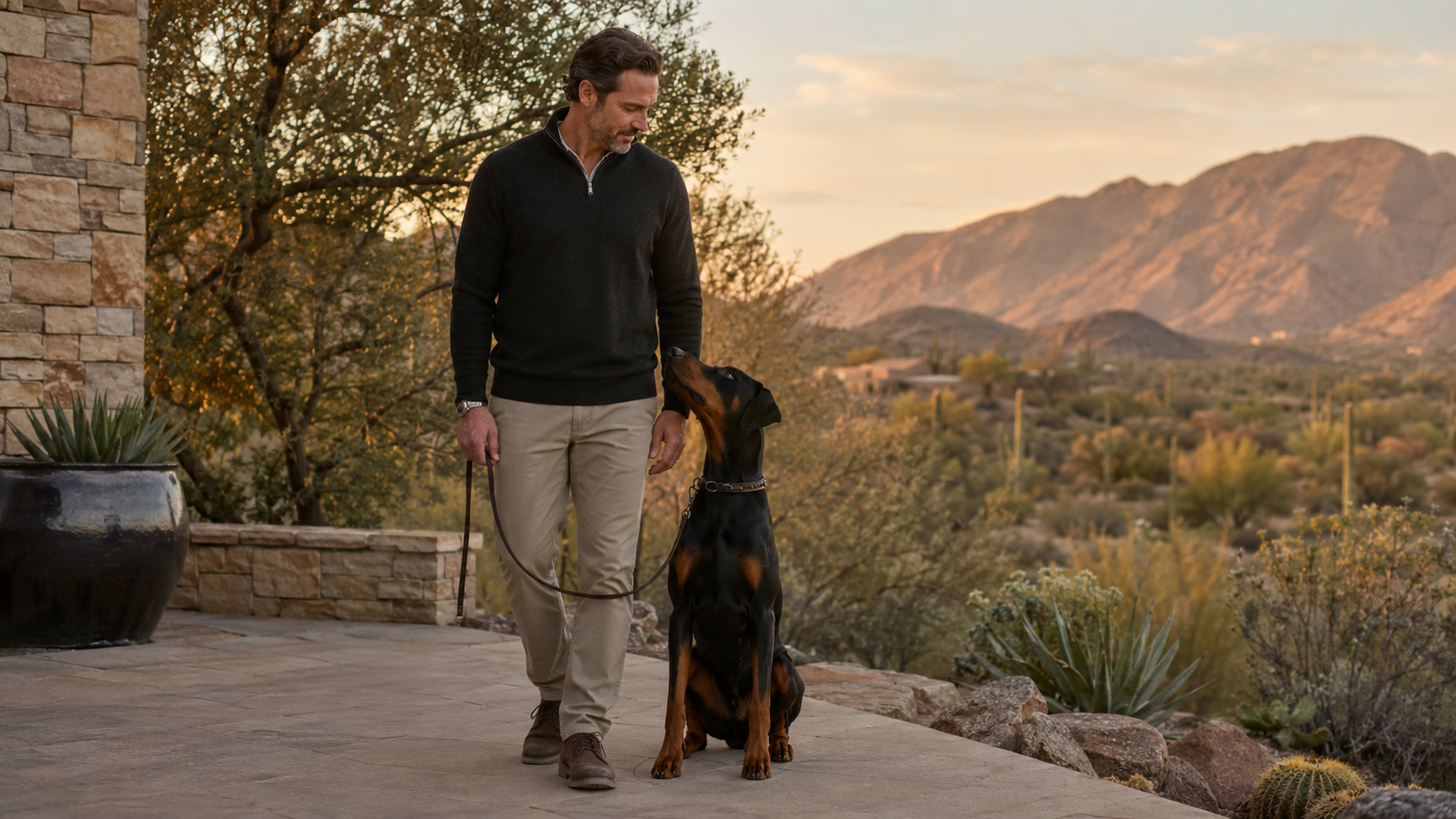
A properly developed protection dog should settle naturally into everyday life as a companion. The obedience, expectations, and structure established during training become part of how the dog lives with its family. Protection is a capability the dog possesses, not a state the dog should constantly live in.
Like any developed skill, however, that capability requires maintenance.
Obedience must remain reliable. The owner's handling must remain clear and consistent. Protection skills should be periodically exercised under appropriate conditions. Physical and mental fitness must be maintained. And as the dog matures, its needs should be reassessed.
The objective is not to continually make the dog more aggressive or suspicious.
It is to preserve what responsible protection training was intended to create in the first place:
A confident, capable dog whose strength remains under control.
Maintenance Begins With Everyday Life
The most important maintenance a protection dog receives usually does not happen during protection work. It happens in everyday life.
Commands should continue to mean what they mean. Household rules should remain consistent. The owner should expect the same standard of obedience whether the dog is at home, walking through town, traveling, greeting visitors, or encountering distractions.
This does not require turning every interaction into a formal training session. It requires consistency.
When an owner gives a command, the dog should be expected to follow it. When a boundary has been established, it should remain a boundary. Small exceptions made repeatedly have a way of becoming new rules.
Regular exercise, play, obedience, and time together also maintain something just as important as individual commands: the working relationship between dog and owner.
For a protection dog, that relationship matters. The dog must remain accustomed to looking to its owner for direction and responding when direction is given.
Protection may be the specialized skill. Reliable everyday obedience is what keeps that skill usable.
Protection Skills Are Perishable
Protection training develops abilities that should not simply be assumed to remain unchanged forever.
Without appropriate maintenance, timing can become less precise, responses can become less clear, and both the dog and owner can become rusty. The dog may remember the work, but remembering a skill and performing it reliably under pressure are not necessarily the same thing.
Maintenance gives the dog periodic opportunities to exercise those skills correctly while also reinforcing the owner's ability to handle the dog.
That does not mean protection work needs to become a constant part of the dog's life. For most family protection dogs, it should not.
The dog should spend far more of its life being a companion than performing protection work.
When protection maintenance is performed, however, it should have purpose. The objective is to preserve confidence, clarity, control, and reliability—not simply to see the dog bite something.
A protection dog should never need to be continually agitated or encouraged to view ordinary people and situations as threats in order to remain capable.
Good maintenance preserves the dog's capability without changing the way the dog lives with its family.
Some Things Should Not Be Practiced at Home
Protection work is not something owners should improvise simply because they want to see whether their dog will still perform.
Having a friend put on protective equipment, staging a confrontation, encouraging suspicious behavior, or creating a situation intended to make the dog believe someone poses a threat can introduce problems that were never present in the original training.
There is also an important difference between maintaining a trained behavior and unintentionally teaching the dog something new.
Protection work involves timing, pressure, communication, equipment, environmental conditions, and an understanding of how the individual dog responds. Poorly structured work can create confusion, weaken control, reinforce undesirable behavior, or undermine confidence.
The same applies to repeatedly “testing” a dog in everyday situations. A protection dog should not have to prove itself for the owner's reassurance.
Everyday obedience and handling belong in everyday life.
Protection maintenance belongs in an appropriate training environment with people who understand the work.
There is little value in testing a good dog simply to see what happens.
The Handler Needs Maintenance Too
Protection dog maintenance is not only about the dog.
The owner is part of the working team, and handling skills can become rusty just as canine skills can. Timing changes. Commands become casual. Expectations can gradually soften. Small habits develop without anyone noticing them.
Periodic professional maintenance provides an opportunity to work on both sides of the leash.
The dog gets appropriate protection work under controlled conditions, while the owner has an opportunity to practice handling, reinforce expectations, and make sure communication remains clear.
It also allows an experienced trainer to see changes that may be difficult for an owner to recognize. A small hesitation, slower response, change in confidence, or developing obedience issue is generally easier to address early than after it has become established.
For Armor K9 clients in Arizona, the Arizona Protection Dog Club provides an opportunity for continued development and maintenance in an appropriate environment.
For clients who live outside Arizona, distance does not mean they are on their own. Armor K9 can help identify an appropriate professional in their area who can work with them and their dog. When needed, arrangements can also be made for Armor K9 to travel to the client for hands-on maintenance and support.
A protection dog may live hundreds or thousands of miles from Armor K9, but our responsibility to the client does not end at delivery.
The purpose is not to keep proving what the dog can do.
It is to help preserve the partnership that makes the dog's capability reliable when it matters.
Maintaining the Dog Physically
A protection dog cannot perform beyond what its body allows.
Maintaining an appropriate weight, good muscle tone, cardiovascular fitness, mobility, and overall health contributes directly to the dog's ability to work when needed. Regular exercise should therefore be part of normal life—not simply something done before a training session.
Routine veterinary care matters as well. Teeth, nails, feet, joints, coat, nutrition, and preventative care can all affect comfort and performance. Even relatively minor physical problems can change the way a dog moves, responds, or behaves.
Owners should also pay attention to changes rather than assuming every difference in performance is a training problem. A dog that suddenly becomes reluctant to perform something it previously did willingly may be uncomfortable or experiencing a physical limitation.
Conditioning should also reflect the dog's age, environment, and lifestyle. The physical needs of a young adult protection dog may be very different from those of a mature dog that has spent years accompanying its family.
The objective is not to maintain a canine athlete for competition.
It is to keep the dog healthy, capable, and physically prepared for the life it is expected to live.
Maintenance Changes Over Time
A protection dog should not be maintained according to a rigid schedule simply because that schedule worked at another point in the dog's life.
A younger dog may benefit from more frequent development and reinforcement as experience accumulates. A mature, experienced dog with strong obedience and established protection skills may require something different. Changes in the owner's lifestyle, household, travel, environment, or expectations can also affect what maintenance is appropriate.
The dog itself should help determine the answer.
As protection dogs mature, experienced trainers can evaluate whether skills remain clear, whether handling remains effective, and whether anything needs additional attention. Maintenance can then be adjusted to the individual dog rather than performed simply because a certain amount of time has passed.
This is another reason an ongoing relationship with a qualified professional has value. Maintenance is not just repetition. It provides an opportunity to evaluate the dog and handler as they are today.
The standard remains consistent even when the maintenance required to preserve it changes.
The goal is not more training. It is the right training, at the right time, for the dog and owner in front of us.
When It Is Time to Retire
There eventually comes a point when every protection dog's working years begin to wind down.
Age alone does not determine that moment. Health, mobility, endurance, recovery, confidence, and the individual dog all matter. The changes may be gradual, and an owner who sees the dog every day may not immediately recognize how much its physical capabilities have changed.
Responsible ownership means being willing to adjust expectations.
Protection maintenance may become less physically demanding or less frequent. Eventually, protection work may no longer be appropriate at all.
Retirement should never require the dog to prove that it can no longer perform.
The dog has already done its job.
And retiring from protection work does not mean retiring from the family. One of the defining qualities of a properly selected and developed family protection dog is that protection was never the entirety of its life in the first place.
It remains what it has always been first:
A companion, a member of the family, and a dog that has earned the opportunity to enjoy the years ahead.
A Lifetime Responsibility
Owning a protection dog carries a different responsibility than simply possessing a dog that has received protection training.
The investment made in selecting, developing, training, and transitioning the dog deserves to be protected through consistent ownership, appropriate maintenance, and good judgement throughout the dog's life.
That does not require making protection the center of everyday life.
Quite the opposite.
A well-maintained protection dog should be able to spend most of its time simply living with its family—going places, exercising, playing, resting at home, and participating in the life it was selected to share.
Maintain the obedience. Maintain the relationship. Maintain the dog's health. Periodically maintain the specialized skills with qualified professionals. And adjust those expectations as the dog moves through different stages of life.
Armor K9's role does not have to end when a protection dog goes home. Whether continued work takes place through the Arizona Protection Dog Club, with a qualified professional closer to the client's home, or through arrangements for Armor K9 to work with the client directly, support remains available.
Because the objective was never simply to deliver a trained protection dog.
It was to create a partnership capable of lasting for the life of the dog.