
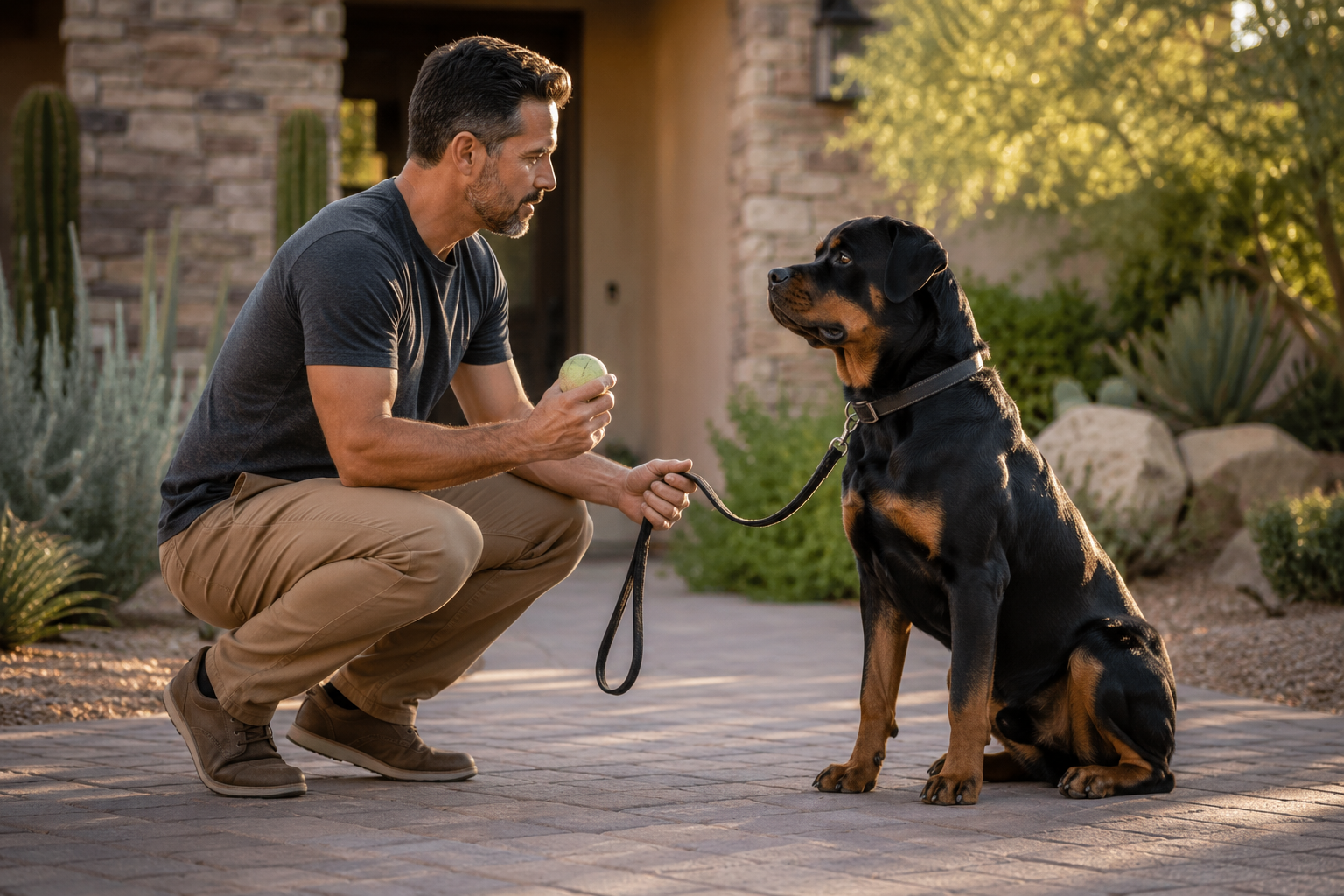
Most conversations about protection training begin with a straightforward request:
“I want my dog trained to protect me or my family.”
Sometimes an owner has seen something in the dog that makes them believe there may be protection potential. The dog may be confident, highly driven, naturally alert, or may have responded to a situation in a way that caught the owner's attention.
But often, the owner simply wants to know whether the dog they already love and live with can be trained for protection.
That's a reasonable question. The answer, however, isn't determined simply by an owner's desire to have a protection-trained dog.
Protection training cannot make every dog a protection dog. The dog must bring certain qualities to the equation, and those qualities have to exist alongside the temperament and stability necessary to live successfully as a family companion.
Breed alone cannot answer the question. Neither can aggression, territorial behavior, enthusiasm for biting a tug, or an impressive bark at the front door.
And even when a dog possesses some of the qualities necessary for protection work, there is another question that matters just as much:
Can this dog do protection work—and should this dog be developed for it?
Those aren't always the same question.
Before pursuing protection training, there are several things you can safely observe in your own dog that may help you decide whether taking the next step toward a professional assessment makes sense.
The goal isn't to test your dog. It's to take a more informed look at the dog you already have.
What You Can Observe in Your Own Dog
You don't need protection equipment or a staged confrontation to begin noticing qualities that may be relevant to protection work. In fact, you shouldn't try to create threatening situations to see what your dog will do.
Some of the most useful initial observations can come from ordinary play and everyday life.
Ball and Toy Drive
How interested is your dog in a ball or favorite toy?
A dog with strong ball or toy drive may become intensely interested as soon as the toy appears. The dog may enthusiastically chase it, search for it when it disappears, bring it back to continue the game, and remain interested through repeated play.
Strong ball or toy drive can be useful in training. It gives us something the dog genuinely wants and enjoys working for.
But a dog that will chase a ball all afternoon isn't necessarily a protection dog. Drive is one piece of a much larger picture.
Prey Drive
Prey drive is the natural desire to pursue something that moves.
You may see it when your dog chases a ball, pursues a moving toy, or becomes highly engaged during an appropriate game of tug. Some dogs immediately come alive when movement is introduced. Others may chase briefly and quickly lose interest.
We're interested not simply in whether the dog will chase, but in the intensity and commitment behind that behavior.
Chasing wildlife isn't a protection assessment. A dog that wants to chase every rabbit or squirrel it sees may have prey drive, but that tells us very little by itself about whether the dog is suited for protection work.
Possession and Persistence
What happens when your dog catches the toy?
Some dogs immediately lose interest. Others want to hold it, carry it, tug with it, or continue the interaction.
You can also notice what happens when achieving something becomes a little more difficult. Does your dog remain interested and keep trying, or quickly decide the game isn't worth the effort?
Persistence can be valuable in a working dog, but—as with every observation in this section—it doesn't stand alone.
Engagement
Pay attention to your dog's relationship with you during play.
Does your dog actively want to participate with you? Does interaction make the game more interesting? Or does the dog simply want to take possession of the object and go somewhere else with it?
Neither behavior answers the protection question by itself. It simply gives us another piece of information about how the dog works and what motivates it.
Confidence and Recovery
Confidence isn't the absence of being startled or uncertain. Dogs notice unexpected things just as people do. What matters is what happens afterward.
In normal life, notice how your dog responds to unfamiliar environments, new surfaces, unexpected noises, strange objects, and other ordinary experiences. If something surprises the dog, does it investigate and move on? Does it recover quickly? Or does the experience continue to affect the dog long afterward?
A dog's ability to encounter something unfamiliar, process it, and recover can tell us much more than whether the dog reacted in the first place.
Observe. Don't Test.
None of these observations determine whether your dog is suitable for protection training. They're simply things you can notice during normal activities without placing your dog, another person, or yourself in an artificial confrontation.
Do not ask a friend to pretend to attack you. Don't have someone threaten your dog to see what happens. And don't attempt to recreate protection exercises you've seen online.
Those situations can produce misleading results and create problems that weren't there before.
At this stage, you're not trying to prove that your dog can protect you. You're simply beginning to understand some of what your dog brings to the table.
Protection Training Cannot Create What Isn't There
One of the most important things to understand about protection training is that training does not manufacture a protection dog.
Training develops, shapes, and controls qualities the dog already possesses.
Genetics play an important role. So do temperament, confidence, drives, resilience, willingness to engage, and the dog's ability to handle pressure. How those qualities come together in the individual dog matters far more than simply teaching a series of protection exercises.
A skilled trainer can develop a dog's confidence, strengthen behaviors, build skills, and teach the dog how to work with its handler. But training cannot reliably install qualities that simply aren't present.
This is one reason a dog looking impressive on protection equipment can be misleading.
A dog may enthusiastically chase a moving sleeve, bite a tug, or engage a decoy during a highly stimulating training exercise. That can demonstrate useful prey drive and certainly may be part of protection development.
But it does not necessarily tell us what the dog will do when the equipment disappears and the interaction becomes about the person rather than the object.
There is an important difference between a dog that enjoys the game and a dog that possesses the temperament and willingness necessary for genuine protection work. Neither should be confused with aggression.
A dog does not need to be angry, suspicious, or looking for conflict to possess protection capability. In fact, those qualities can create entirely different concerns.
The purpose of protection development is not to turn a friendly dog into an aggressive one. It is to determine whether the appropriate underlying qualities already exist and, when they do, develop those qualities while preserving the stable dog you want beside you in everyday life.
Protection training should develop the dog. It should not fundamentally change who the dog is.
Breed Matters, But It Doesn't Answer the Question
Certain breeds are associated with protection work for good reason.
German Shepherds, Belgian Malinois, Dutch Shepherds, Rottweilers, Dobermans, Giant Schnauzers, and several other breeds have characteristics and working histories that can make them well suited for protection work.
But owning one of those breeds doesn't mean you own a protection dog.
There can be enormous differences between individual dogs of the same breed. Genetics, breeding priorities, temperament, drives, confidence, physical ability, and individual personality all influence what a particular dog may be capable of.
Genetics help us paint the picture. They can give us an idea of what qualities may be there and what we might reasonably expect as the dog develops. But they don't give us the entire picture. The individual dog still matters.
A German Shepherd bred primarily as a family companion may be very different from another German Shepherd produced from generations of working dogs. Even within the same litter, individual dogs can possess very different qualities.
The same is true in the opposite direction.
A dog doesn't necessarily have to come from one of the breeds most commonly associated with protection work to possess useful qualities. Some less typical breeds—and occasionally individual dogs you might not expect—can demonstrate legitimate potential.
That doesn't mean every large, powerful, or confident dog should be considered a protection prospect. Size and appearance don't create protection ability any more than a particular breed name does.
Breed and genetics help us paint part of the picture.
Ultimately, the individual dog has to show us what is actually there.
Aggression Is Not Protection Ability
One of the most common misconceptions about protection dogs is that an aggressive dog is naturally a good candidate for protection training.
It isn't that simple.
A dog that barks or lunges at strangers, reacts aggressively toward other dogs, guards the house, or becomes threatening when uncomfortable may certainly look protective to its owner. But those behaviors can come from many different places, including fear, insecurity, reactivity, territorial behavior, frustration, or learned behavior.
None of those behaviors, by themselves, demonstrate protection ability.
The same is true of a dog with a bite history.
The fact that a dog has bitten someone does not mean the dog has demonstrated protection capability. The circumstances surrounding the bite matter. A dog may bite because it is frightened, cornered, overstimulated, guarding something, reacting territorially, or responding to a situation it doesn't know how to handle.
A bite history doesn't automatically mean a dog can never be considered for protection work, either. It does mean the history needs to be understood before deciding whether protection development is appropriate.
A dog behaving aggressively because it is afraid is very different from a confident, stable dog that is capable of engaging when asked and disengaging when requested.
Protection training should not be used as a way to fix aggression. It also should not be used to encourage an unstable or unpredictable dog to become more willing to engage people.
The dog needs the ability and willingness to protect when genuinely needed, but it also needs the stability to live normally when protection isn't needed—which is almost all of the dog's life.
A protection dog should be able to spend time with the family, go places, encounter unfamiliar people, relax in the home, and participate in everyday life without constantly looking for something to protect against.
The goal isn't to create a dog that makes the family feel safer by making everyone else feel unsafe.
A protection dog isn't defined by how readily it becomes aggressive. It is defined by capability under control.
Confidence and Stability Matter
Protection work asks more of a dog than the ability to engage a threat. The dog also has to be capable of navigating everyday life with confidence and stability.
That doesn't mean a protection dog must be fearless. Dogs can be startled, uncertain, or cautious about something unfamiliar. What matters is how the dog processes the experience and what happens next.
Does the dog investigate and recover? Can the dog move forward after being surprised? Can it enter an unfamiliar environment and settle into it? Or does uncertainty continue to build until the dog becomes overwhelmed, shuts down, or reacts?
Protection dogs don't spend most of their lives doing protection work. They live with people.
They encounter visitors, delivery drivers, neighbors, children playing, unfamiliar sounds, new places, veterinary appointments, travel, and countless ordinary situations that should not become protection events.
A capable protection dog needs to distinguish between everyday life and circumstances in which its protection skills are actually being called upon.
Stability also matters when excitement rises. A dog can have tremendous drive and still need the ability to think, respond to its handler, and transition back out of that heightened state.
This is one reason the most intimidating-looking dog isn't necessarily the strongest protection candidate. A dog that reacts to everything may appear impressive, but constant suspicion and unnecessary reactions aren't the qualities we're trying to develop.
Confidence allows the dog to face something difficult. Stability allows the dog to live normally when nothing difficult is happening.
A protection dog needs both.
Obedience Is Part of Protection
Protection capability without obedience creates a problem.
A dog may have confidence, drive, willingness, and physical ability, but those qualities have to remain connected to the person responsible for the dog.
Protection work should not remove the owner from the equation. The dog needs to respond to direction before, during, and after protection work.
That includes much more than whether the dog will sit or heel when everything is calm.
The real question is whether the obedience remains usable when the dog's excitement and intensity increase. Can the owner communicate with the dog when the dog is highly engaged? Can the dog respond to direction, release when requested, disengage, and move forward with the owner?
This is why we consider obedience part of protection rather than something separate from it.
It also means the owner's responsibility doesn't end when the protection training is completed. A protection-trained dog needs leadership, structure, rules, consequences, and consistency throughout its life. Skills need to be maintained, expectations need to remain clear, and the owner needs to be willing to remain involved.
For someone considering protection training for a dog they already own, that creates another important question:
Are you prepared to become part of the training, too?
The goal isn't simply a dog capable of protecting you. It is a dog whose capability remains usable because you can direct it when it matters.
What About a Family Dog?
Being a loving family companion does not disqualify a dog from protection work.
Affection, playfulness, and sociability aren't weaknesses. A dog doesn't need to dislike people or become suspicious of the world around it to possess legitimate protection capability.
Appropriate protection development should add a skill set without taking away the qualities you already value in your dog.
Companion first. Protector second.™
Age and Development Matter
Owners sometimes begin thinking about protection training while their dog is still a puppy.
There is nothing wrong with noticing promising qualities early. Confidence, curiosity, prey drive, toy interest, persistence, and engagement can all begin showing themselves while a dog is young.
But a puppy is still developing.
What we see early can help us begin painting the picture, but it doesn't tell us with certainty what the finished dog will become. Temperament continues to develop, drives can strengthen or change, and adolescence can reveal qualities that weren't apparent when the dog was younger.
That doesn't mean nothing should be done with a young dog.
Good obedience, appropriate socialization, environmental exposure, play, confidence building, and a strong relationship with the owner can create an excellent foundation without trying to prove that a puppy will someday become a protection dog.
Protection development can also be age and dog appropriate. With a young dog, that may mean keeping the work fun and allowing useful drives and behaviors to develop without placing expectations on the dog that it isn't mature enough to handle.
The mistake is assuming that early enthusiasm guarantees future protection capability.
A promising puppy may give us reasons to continue watching and developing. The dog still has to grow up and show us who it becomes.
Can My Dog? vs. Should My Dog?
Finding protection potential in a dog answers only part of the question.
A dog may possess the confidence, drives, temperament, and willingness that suggest protection development is possible. That still doesn't automatically mean pursuing it is the right decision.
The dog has to be considered as a whole.
So does the person holding the leash.
Why do you want your dog protection trained? What do you expect the dog to do? How does the dog fit into your household and everyday life? And are you prepared to maintain the obedience, structure, training, and responsibility that come with developing that capability?
Those questions matter because protection training changes what a dog knows how to do. Once that capability is developed, the owner assumes responsibility for managing it appropriately.
Sometimes an assessment may show that a dog has some useful qualities, but that continuing into protection development isn't the best choice.
That isn't a failure.
The objective should never be to turn every capable dog into a protection dog. It should be to determine whether developing protection capability makes sense for this particular dog and the person and family who will live with it.
“Can my dog do this?” is an important question.
“Should my dog do this?” is the more important one.
The Protection Assessment
The observations you make at home can help you decide whether exploring protection training makes sense. They cannot tell you everything we need to know.
That is the purpose of a protection assessment.
A proper assessment isn't simply about seeing whether a dog will bite something. A dog grabbing a tug or biting protection equipment may tell us something useful, but it doesn't answer the larger question.
The assessment is about understanding the dog in front of us.
We want to determine whether the qualities necessary for protection development appear to be present, where the dog is in its development, and whether moving forward would be appropriate.
The dog's history matters, too. Age, background, previous training, behavior concerns, and any bite history can provide important context for what we see.
Sometimes the answer is yes. Sometimes we see enough potential to recommend limited development and reevaluation as the dog progresses. And sometimes the right answer is no.
An honest assessment isn't about finding a reason to sell protection training. It is about determining whether protection training is appropriate for the individual dog and owner.
The purpose isn't to prove what we hope the dog can do. It is to understand what the dog actually brings to the table.
When the Answer Is No
Sometimes the right answer is no.
That may be because of the dog. It may be because protection training isn't appropriate for the owner or household. Sometimes it is the combination of the two.
None of those conclusions should be taken as a judgment of the dog or the owner.
A dog can be an exceptional companion and still not possess the qualities necessary for protection work. There is nothing wrong with that dog and nothing that needs to be fixed.
Likewise, deciding that protection training isn't appropriate for an owner doesn't mean that person is a bad dog owner. Protection work brings additional responsibility, expectations, and management. It also requires the right relationship between the dog and the person responsible for directing it.
There may also be situations where the dog has legitimate potential and the owner simply isn't prepared for what developing and maintaining that capability requires. In that case, moving forward because the dog can do the work isn't necessarily the responsible decision.
An honest assessment has to leave room for all of those answers.
Sometimes the most responsible recommendation we can make is to leave a good dog exactly what it already is—a good dog.
A “no” isn't a failure. It's an answer.
When the Answer Is Yes
Sometimes the assessment gives us good reason to move forward.
That doesn't mean the dog is now a protection dog. It means we believe the dog possesses enough of the right qualities to justify developing them.
Protection development is a process.
As training progresses, we learn more about the dog. Drives can be developed, skills can be introduced, obedience can become more reliable around increasing levels of excitement, and the dog can gradually be asked for more as it demonstrates that it is ready.
The dog continues to show us what it is capable of along the way.
An initial assessment is a starting point, not a guarantee of what the finished dog will become. Development may confirm what we saw in the beginning, reveal greater capability than expected, or show us limitations that weren't apparent during the initial assessment.
The objective isn't to force the dog toward a predetermined result.
It is to develop what is genuinely there while maintaining the stability, obedience, and companionship that make the dog suitable for life with its owner.
When the dog and owner are both appropriate for the work, protection development can begin with a clear understanding of what we're trying to accomplish—and why.
A positive assessment tells us there is reason to move forward. What follows is the development of the dog and the owner as a team.
Is Protection Training Right for Your Dog?
You can learn quite a bit by paying attention to the dog you live with.
Ball and toy drive, prey drive, persistence, confidence, recovery, engagement, and everyday behavior can give you reasons to explore the question further. Your dog's breed, genetics, history, and previous training can help add to the picture.
But none of those things answers the question by itself.
Protection training requires the right dog, but it also requires the right owner. Capability, stability, obedience, expectations, responsibility, and the relationship between the two all matter.
You don't need to test your dog or try to prove what it will do.
If you're wondering whether your dog may be appropriate for protection work, the next step is simply to have the dog—and your goals for the dog—properly evaluated.
You may discover that protection development makes sense.
You may discover that it doesn't.
Either answer is valuable because the objective should never be to make a dog into something it isn't.
The goal is to understand the dog you have, determine what it may genuinely be capable of, and decide whether developing that capability is right for both of you.