Choosing the Right Training Program Begins With the Dog—and the Owner
Choosing a dog training program can appear fairly straightforward. Find the behavior you want to change, select a program that addresses it, and begin training.
In practice, the right choice requires a little more thought.
Two dogs of the same age with similar training experience may need very different approaches. Temperament, maturity, previous training, behavior, lifestyle, and the environment in which the dog lives all help determine what kind of training is appropriate.
The owner matters just as much.
How involved do you want to be in the training? How much time can you realistically devote to practice? Where does your dog need to behave reliably? What does everyday life with your dog look like now—and what would you like it to look like when training is complete?
These questions matter because the goal is not simply to put a dog through a training program.
The goal is to choose the training that makes sense for the individual dog, the owner, and the life they share.
Start With the Outcome, Not the Program Name
It is natural to begin by looking at training programs.
Private lessons. Board and train. Basic obedience. Advanced obedience.
But those are methods of getting somewhere. They are not the destination.
A better place to begin is with a simple question:
What would you like life with your dog to look like when training is complete?
For one family, success may mean a dog that stops jumping on guests, walks politely on a leash, comes when called, and settles when asked.
Another owner may want greater reliability in public, stronger obedience around distractions, dependable off-leash control, or a dog that can comfortably accompany them through more of their daily life.
The appropriate level of training depends on that desired outcome.
This is also why choosing the most extensive training program is not necessarily the best decision. A dog should receive enough training to meet the owner's needs and expectations without adding complexity simply for the sake of doing more.
Good training begins with a clear definition of what success should look like.
How Involved Do You Want to Be in the Training?
One of the most important differences between training programs is not what the dog learns. It is how the owner participates in the process.
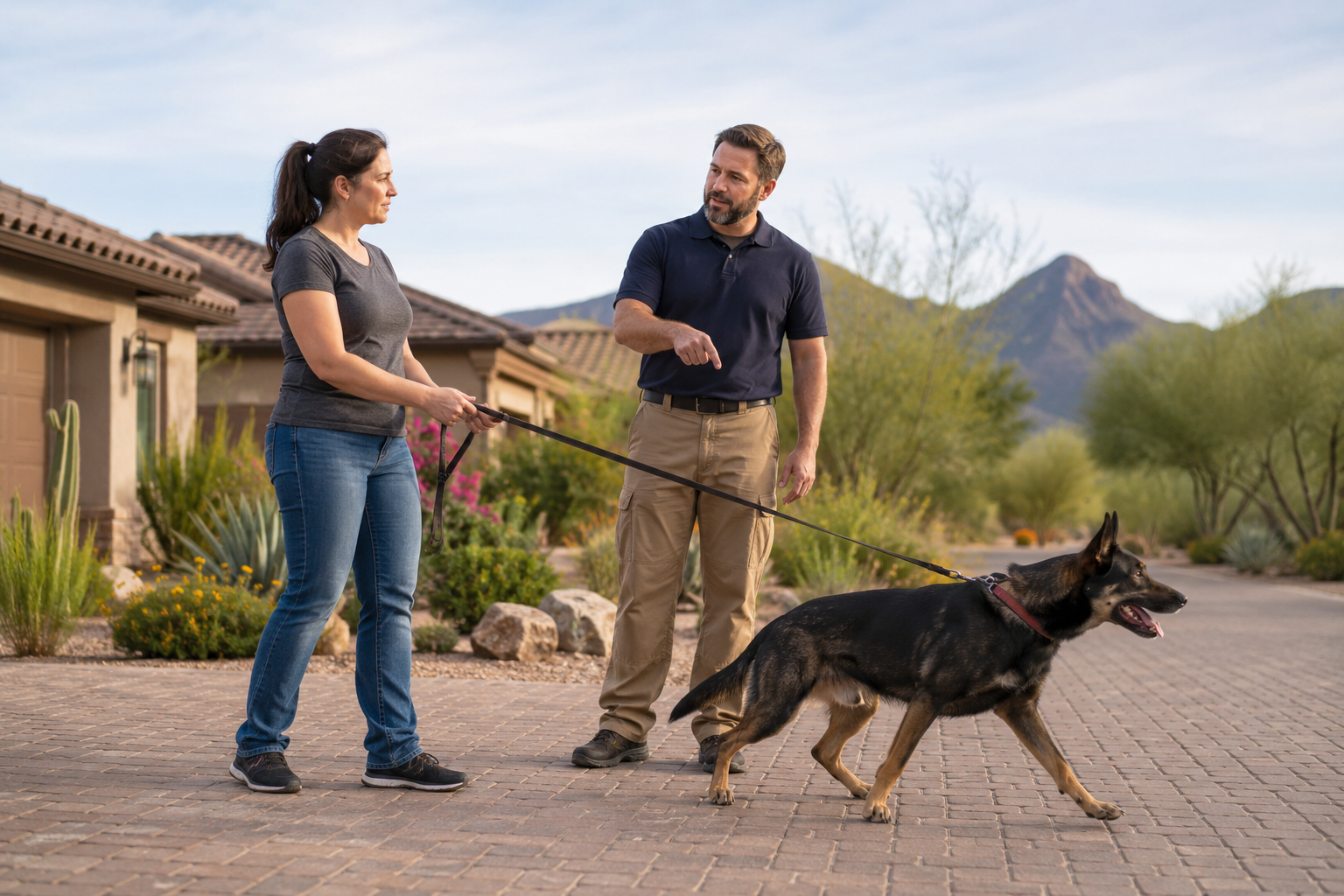
Private training allows the owner to learn alongside the dog. The trainer provides instruction and guidance, but much of the progress happens through the owner's practice between sessions.
For some people, that involvement is exactly what they want. They enjoy learning the process, have the time to practice consistently, and want to develop their handling skills as the dog's training progresses.
Other owners may have demanding schedules, limited time for daily training, or simply prefer to have the foundation established for them. A residential Board & Train program can make more sense in those circumstances.
That does not remove the owner from the equation.
When the dog returns home, the owner still needs to understand how the dog has been trained, how to communicate clearly, and how to maintain the expectations that have been established.
The difference is primarily where the initial work happens and who carries more of that responsibility during the training period.
Neither approach is inherently better.
The right one is the approach the owner can realistically participate in and maintain once formal training is complete.
What About Group Training?
Group training classes are one of the most common ways owners are introduced to dog training.
They can provide an opportunity to learn basic skills while practicing around other dogs and people. For some owners and dogs, that may be sufficient.
The limitation is inherent in the format.
A trainer working with several dogs and owners at the same time cannot devote the same attention to each individual team that is possible during private training. Dogs also do not learn at identical speeds, respond to the same techniques in exactly the same way, or arrive with the same strengths and difficulties.
The curriculum therefore has to move at a pace that serves the class as a whole.
There is also an important difference between training in the presence of distractions and having distractions built into every training session. A dog that is still learning a behavior may benefit from first understanding what is expected before progressively being asked to perform it around greater distractions.
For owners seeking individualized instruction, specific behavioral expectations, or a higher degree of reliability, private or residential training allows the training to be built around the individual dog rather than around the class.
Group training is a format. Whether it is the right format depends on what the dog and owner need from the training.
How Much Training Does the Dog Actually Need?
Not every dog needs advanced obedience.
For many families, the goal is straightforward: a dog that comes when called, walks politely, settles when asked, respects household boundaries, and is easier to live with.
That may be all the training they need.
Other owners expect more. Their dog may regularly accompany them in public, travel with them, encounter significant distractions, or need a higher level of reliability both on and off leash. Those expectations require additional training and proofing.
The distinction is important because knowing a command and performing it reliably are not the same thing.
A dog may understand Sit in the living room but struggle when the environment becomes more interesting. Increasing reliability requires gradually asking the dog to perform known behaviors under greater distance, distraction, and real-world pressure.
That additional work can be valuable when the owner's lifestyle requires it.
But complexity should have a purpose.
The appropriate amount of training is the amount necessary to create the reliability the owner actually needs in everyday life.
Age and Development Matter
A puppy and an adolescent or adult dog should not be approached as though they are simply at different points on the same training checklist.
Young puppies are still learning how to live with people. Housebreaking, crate routines, bite inhibition, handling, boundaries, confidence, and the earliest foundations of obedience are developing alongside the puppy itself.
At this stage, training should help establish good habits while introducing skills in a way that is appropriate for the puppy's age and maturity.
As dogs grow, expectations can increase.
An older puppy or adult dog is generally capable of greater concentration, more structured obedience, and progressively higher expectations for reliability. Training can begin moving beyond introducing behaviors toward asking the dog to perform those behaviors consistently in everyday situations.
Age alone, however, does not determine readiness.
Dogs mature at different rates. Temperament, confidence, previous experiences, physical development, and prior training all influence what should reasonably be expected from an individual dog.
Starting early can provide an excellent foundation. Starting later does not mean the opportunity has been missed.
The important question is not simply how old the dog is, but what the dog is developmentally ready to learn.
Training Is Different From Behavior Modification
Not every problem with a dog is an obedience problem.
Pulling on the leash, jumping on guests, ignoring a known command, or becoming overly excited can often be addressed within a well-structured obedience program.
Aggression, a history of biting, severe fear, or separation anxiety are different.
A dog experiencing one of these problems may also need obedience training, but teaching additional commands does not necessarily address the underlying behavior. Treating the two as though they are interchangeable can create unrealistic expectations about what a training program is intended to accomplish.
This distinction matters when choosing a program.
Owners should be candid about significant behavioral concerns before training begins, including previous incidents that may affect how the dog should be handled or evaluated. That information helps determine whether a standard training program is appropriate or whether the dog requires a different approach.
The first step is understanding what kind of problem you are actually trying to solve.
What About the E-Collar?
For some owners, the use of an electronic collar becomes one of the first considerations when comparing training programs.
It should not be the deciding factor.
An e-collar is a training tool. Like a leash, collar, food reward, or other piece of training equipment, its usefulness depends on how, when, and why it is used.
At Armor K9, an e-collar is not necessary for every level of training. Some programs do not include one, while more advanced programs may incorporate one when appropriate for the individual dog.
When used, the dog is first taught what is expected through training. The e-collar is then introduced as part of an established communication system rather than as a substitute for teaching.
There may also be dogs for which its use is not appropriate. That decision should be based on the individual dog rather than a predetermined belief that every dog must be trained the same way.
Owners certainly should understand the tools that will be used with their dog. But choosing a training program primarily because it does—or does not—include a particular tool puts the equipment ahead of the objective.
Choose the level of training your dog needs first. The appropriate tools should follow.
When Protection Is Part of the Goal
An interest in protection changes the conversation, but it does not eliminate the need for ordinary obedience and good household behavior.
A dog being considered for protection work still needs to live successfully as a companion. The ability to settle in the home, travel with the family, behave appropriately around people, and respond reliably to its owner remains important.
Protection work is a separate training objective.
Not every dog that can learn advanced obedience has the temperament or natural characteristics necessary for protection development. Breed alone does not answer that question, nor does enthusiasm for a toy, barking at strangers, or appearing protective at home.
That is why an owner interested in protection should identify that goal before selecting an obedience program.
For appropriate dogs enrolled in certain Armor K9 training programs, a Protection Assessment & Development option can be incorporated into training. The purpose is to evaluate the dog's interest and potential while developing only enough to help determine whether pursuing formal Protection Development makes sense.
It is not intended to turn an obedience dog into a protection dog during the program.
If the dog demonstrates appropriate potential and the owner decides to continue, protection development becomes its own training path.
Protection should be pursued deliberately—not simply added because a dog appears capable of biting.
Matching Armor K9's Training Programs to Different Needs
Once the desired outcome, the dog's age and development, and the owner's preferred level of involvement are understood, the differences between training programs become much easier to see.
Puppy Headstart is intended for young puppies at the beginning of that process. The emphasis is on introducing useful behaviors, establishing good habits, and creating a foundation that can be built upon as the puppy matures. It can be completed through private training or a short residential stay and is designed to lead naturally into more structured training as the puppy gets older.
Essentials is for owners who want a well-mannered dog and reliable everyday obedience without pursuing a more advanced level of training. It is taught privately, allowing the owner to participate directly while developing the skills most families use regularly.
Cutting Edge is also private training, but it goes considerably further. It adds more advanced obedience, work at distance and in motion, field trips, greater exposure to real-world distractions, and a higher expectation for reliability. An e-collar may be incorporated as part of the training when appropriate.
Board & Train provides a more immersive option. The dog stays with Armor K9 for three weeks while the foundation and more advanced obedience are established through daily training and real-world exposure. It is particularly useful for owners who want that level of training but cannot—or would prefer not to—participate in the daily development themselves. The owner is then taught how to handle and maintain the trained behaviors when the dog returns home.
For suitable dogs whose owners are interested in protection, Protection Assessment & Development may be added to Cutting Edge or Board & Train. Dogs demonstrating appropriate potential may later be considered for Protection Development, which is a separate, long-term training commitment rather than another level of obedience training.
These programs are intentionally different because owners, dogs, and expectations are different.
The question is not:
Which Armor K9 program is the best?
It is:
Which program provides the right level of training for this dog, this owner, and the life they intend to share?
The Owner Is Part of the Training Equation
Professional training can accomplish a great deal with a dog.
What happens afterward matters just as much.
Dogs learn not only from formal training sessions, but from the patterns of everyday life. The behaviors owners reinforce, the boundaries they maintain, and the expectations they consistently follow all influence whether training becomes part of the dog's normal way of living.
That does not mean owners need to become professional dog trainers.
It does mean they need to understand how to communicate with their dog and be willing to maintain what has been taught.
This is particularly important when comparing private training with Board & Train. Private training places more of the development in the owner's hands from the beginning. Board & Train places more of the initial work in the trainer's hands, but the responsibility eventually returns to the owner.
A professionally trained dog still needs leadership, structure, rules, consequences, and consistency at home.
The right training program therefore has to fit more than the dog. It also needs to fit what the owner is realistically prepared to maintain.
Training can establish the standard. Everyday life is where that standard becomes lasting behavior.
Why Armor K9 Begins With a Conversation
Choosing a training program from a list of services can be convenient.
It is not always the best way to make the decision.
An owner may believe the dog needs advanced obedience when a simpler program would accomplish everything they actually want. Another may initially be looking for basic training but describe expectations that require considerably more reliability. Sometimes the concern that brought the owner to training is not primarily an obedience issue at all.
That is why Armor K9 begins with a complimentary evaluation before recommending a training program.
The conversation gives us an opportunity to understand the dog, the owner's concerns, what has already been tried, how the dog fits into the household, and what the owner expects life to look like after training.
From there, we can determine which program makes sense.
Sometimes that means recommending a more comprehensive program. Sometimes it means recommending less training than the owner originally considered. And occasionally, it means explaining that what the owner needs is outside the purpose of our programs.
The objective is not to place every dog into a program.
It is to make the right recommendation before training begins.
Choosing Enough Training—Without Buying More Than You Need
It is easy to assume that more training must produce a better result.
That is not necessarily true.
The value of a training program is not measured by the number of commands taught, the amount of equipment used, or whether the dog completes the most advanced program available. It is measured by whether the training produces the behavior and reliability the owner actually needs.
For one household, that may mean dependable everyday manners and a handful of useful commands.
For another, it may mean advanced obedience, greater reliability around distractions, off-leash control, or preparation for future protection development.
Both can represent successful training.
The difference is the life the dog is being prepared to live.
Choosing appropriately also means recognizing when additional training would provide meaningful value—and when it would simply provide more training.
At Armor K9, the goal is not to sell every owner the largest program.
It is to understand what you expect from your dog, evaluate what your dog needs to get there, and recommend the appropriate path forward.
Because the right training program is not necessarily the one that teaches the most.
It is the one that helps you and your dog live well together when the training is over.